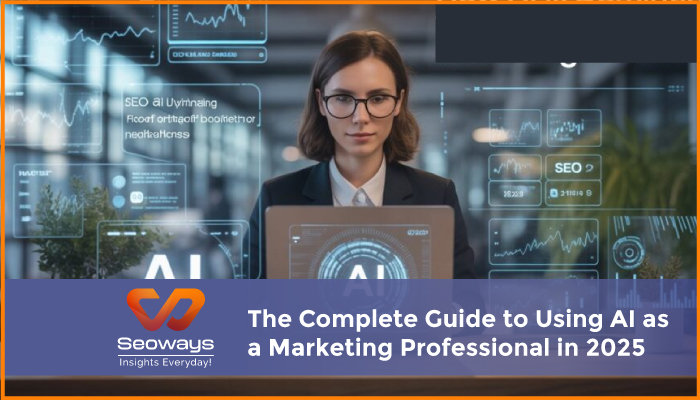
Artificial intelligence is no longer a futuristic concept; it has become a vital tool for marketing professionals in 2025. From automating repetitive tasks to delivering highly personalized customer experiences, AI can transform every aspect of marketing. Businesses that leverage AI effectively can gain a competitive edge, boost conversions, and optimize campaigns like never before. In this guide, we’ll explore how marketing professionals can use AI in practical ways, share real-life examples, and provide actionable strategies for immediate implementation.
Example: A SaaS company used AI to analyze customer interaction data and segment audiences for personalized email campaigns, resulting in a 35% higher open rate.
AI in marketing refers to the use of algorithms and machine learning models to analyze data, predict customer behavior, and automate decisions. AI helps marketers understand their audience better, create targeted campaigns, and improve overall efficiency.
Key Takeaways:
AI tools can generate blog posts, social media content, and ad copy with minimal input. The key is to use AI as a creative assistant rather than a replacement.
Example: A marketing agency used AI to draft initial social media posts for a product launch. Human editors then refined the tone, resulting in engaging and consistent messaging across platforms.
Best Practices:
AI excels at analyzing user behavior to deliver personalized experiences. Predictive analytics allows marketers to segment audiences based on interests, past behavior, and intent.
Example: An e-commerce brand implemented AI-driven product recommendations on their website, increasing average order value by 20%.
Actionable Tips:
AI tools can optimize posting schedules, suggest trending topics, and analyze engagement metrics. Social listening powered by AI helps marketers understand sentiment and trends in real-time.
Example: A fashion brand used AI to identify emerging trends on Instagram. They created timely campaigns around viral styles, increasing reach and engagement.
Tips for Marketers:
AI can identify high-potential keywords, optimize content for search intent, and predict ranking trends. AI-powered tools also help analyze competitors’ strategies and spot content gaps.
Example: A travel blog used AI to optimize content around conversational queries like “best family-friendly resorts in Kerala,” resulting in higher organic traffic from voice search.
SEO Tips:
AI can automate repetitive tasks such as lead scoring, email follow-ups, and ad bidding. This allows marketing teams to focus on strategy and creativity rather than routine operations.
Example: A B2B company implemented AI-driven lead scoring. Sales teams prioritized high-potential leads, improving conversion rates by 25%.
Best Practices:
AI helps marketers process large datasets to identify patterns and insights. Predictive analytics can forecast trends, customer behavior, and campaign performance.
Example: An online retailer used AI to analyze past campaign data and predict seasonal product demand. This guided inventory planning and marketing strategy.
Tips:
While AI is powerful, marketers must consider ethics, transparency, and privacy. AI is only as effective as the data it uses, so biased or inaccurate data can produce misleading results.
Example: A company faced backlash for AI-driven ad targeting that unintentionally excluded certain demographics. They revised their algorithms and implemented checks for fairness.
Guidelines:
AI will continue to evolve with advances in natural language processing, computer vision, and predictive modeling. Marketing professionals should stay updated on emerging tools and trends to remain competitive.
Example: Early adopters of AI video content generation gained a significant advantage in engagement and reach over competitors.
Actionable Steps:
AI is transforming marketing in 2025, offering tools to optimize content, personalize experiences, automate tasks, and predict customer behavior. By understanding the capabilities and limitations of AI, marketing professionals can integrate it effectively into their strategy. Combining human creativity with AI-driven insights ensures campaigns are efficient, impactful, and ready to engage the modern audience.
| Section | Key Focus | Practical Application |
| 1. Understanding AI in Marketing | Predictive analytics and automation | Enhance audience insights and decision-making |
| 2. AI-Powered Content Creation | Drafts, ideas, social content | Improve efficiency while maintaining brand voice |
| 3. Personalization and Segmentation | Audience targeting based on behavior | Increase engagement and conversions |
| 4. AI in Social Media Marketing | Trend analysis, scheduling, sentiment | Optimize campaigns and engagement |
| 5. AI-Driven SEO Strategies | Keywords, intent, content optimization | Boost organic traffic and rankings |
| 6. Marketing Automation with AI | Lead scoring, follow-ups, ad bidding | Save time and improve performance |
| 7. AI for Analytics and Insights | Predictive analytics, dashboards | Make data-driven marketing decisions |
| 8. Ethical Considerations | Privacy, bias, transparency | Maintain trust and compliance |
| 9. Preparing for the Future | Emerging AI tools, upskilling | Stay competitive and innovative |


Request your best quote today!”

With the #1 Digital Marketing Agency!
We specialize in SEO, driving traffic, enhancing online visibility, and transforming markets with innovative strategies.
Seoways LLP,
1st Floor, SKK Complex,
Mohanur Road,
TN – 637001
Skype/Telegram: Seoways
Phone: +91 959 77 00 888