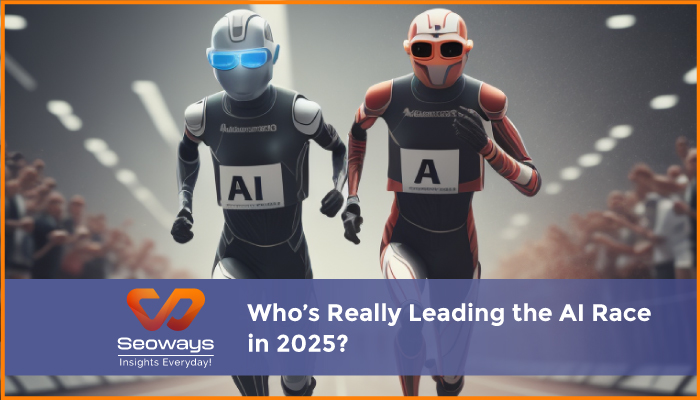
Artificial Intelligence has evolved from a niche research topic to a global powerhouse shaping industries, governments, and everyday life. From automated customer service to self-driving cars, AI is everywhere. As we reach 2025, the big question is: who truly leads the AI race? Are established tech giants still firmly ahead, or are emerging players rewriting the rules?
The answer is nuanced. The race is not only about developing smarter models. It’s about infrastructure, deployment, adoption, government support, and the ability to scale safely and efficiently. To understand the landscape, let’s look at the leading players, the emerging challengers, and the global dynamics shaping AI today.
Alphabet (Google)
Google, under its parent company Alphabet, has long been synonymous with AI. Their Gemini AI model has taken center stage, powering search, productivity tools, and cloud services. In Q2 of 2025, Alphabet reported a nearly 32% revenue surge in its cloud division, a leap largely fueled by AI adoption and the integration of Gemini AI across products.
A personal observation from a friend working in cloud infrastructure: Google Cloud’s AI APIs have dramatically reduced development time for AI projects, making them more accessible to smaller businesses. This accessibility gives Google a strategic edge—they are not only developing advanced models but also embedding them into tools millions of people already use.
Microsoft
Microsoft has steadily transformed its business through AI. Its collaboration with OpenAI brought tools like GitHub Copilot and Microsoft 365 Copilot into the mainstream. These products automate repetitive tasks and help with coding, content creation, and data analysis.
I attended a virtual conference where a mid-sized marketing firm shared how they saved weeks of work using Microsoft Copilot for campaign strategy planning. This real-world adoption shows that Microsoft is not just innovating in labs but directly influencing how businesses operate.
Nvidia
Nvidia remains an undeniable powerhouse in AI infrastructure. With a market capitalization of $4.26 trillion, the company dominates the GPU market, which is the backbone of almost all large-scale AI computation. Analysts project Nvidia could reach a $9 trillion valuation by 2030 due to soaring demand for AI hardware.
A university research lab I visited demonstrated that without Nvidia GPUs, training large language models would have been prohibitively slow and expensive. Leadership in AI is not just about algorithms—it’s about enabling the infrastructure that makes them possible.
OpenAI
OpenAI continues to push the boundaries of generative AI. Their models, including GPT-4 and DALL·E, are widely used for creative and business applications. Beyond technology, OpenAI emphasizes safe and responsible AI, which is increasingly important as governments and companies demand ethical deployment.
From personal experience using ChatGPT, I noticed how businesses leverage it for drafting emails, creating SEO content, and brainstorming ideas that previously took hours of human effort. This adoption shows OpenAI’s influence beyond the tech elite—it’s shaping everyday workflows.
xAI
Elon Musk’s xAI is another exciting entrant. Although relatively new, the company focuses on transparency and ethical applications. xAI explores multi-agent systems and innovative neural network architectures that could challenge conventional models. Their bold approach makes them a wild card in the race.
CoreWeave
CoreWeave provides GPU-accelerated cloud infrastructure for AI applications. Recent funding rounds highlight the growing demand for specialized computing resources. CoreWeave is particularly notable because it enables startups to access cutting-edge infrastructure without building it in-house.
Governments are pivotal in shaping AI leadership. In the United States, collaboration between tech leaders and policymakers aims to maintain global dominance. Incentives for research, grants, and supportive regulations help companies scale faster.
I spoke with a friend at a Washington-based AI startup who mentioned that government-backed programs gave them access to advanced computing resources that would otherwise be cost-prohibitive. This shows AI success is determined not just by talent or capital but also by supportive policies.
China is investing heavily in AI infrastructure and talent development. Domestic models are closing the performance gap, and government support ensures rapid deployment in key sectors. By 2024, U.S. institutions produced 40 notable AI models compared to China’s 15. However, performance differences on benchmarks shrank dramatically, illustrating intensifying competition.
AI leadership is measured by impact. Alphabet integrates AI into search, email, cloud, and advertising. Microsoft powers enterprise productivity and creative workflows. Nvidia fuels AI research globally. Emerging players like OpenAI influence creative industries, while xAI and CoreWeave enable startups to access cutting-edge infrastructure.
For instance, a small marketing agency I know started using AI-powered analytics to optimize ad campaigns in real time. Within a month, their conversion rates improved by 23 percent. This shows even mid-sized businesses can benefit from AI advancements if they choose the right platforms.
The AI race is global. The U.S. still leads in model development and innovation, but China and Europe are rapidly closing gaps. Collaboration between governments, startups, and universities creates diverse ecosystems that foster innovation.
While the U.S. dominates research and infrastructure, Chinese AI models are increasingly competitive, especially in natural language processing and computer vision. Europe focuses on regulatory compliance and ethical AI, which could become a competitive advantage as global scrutiny of AI increases.
The AI race in 2025 is dynamic. Established leaders like Alphabet, Microsoft, and Nvidia drive innovation at scale. Emerging players such as OpenAI, xAI, and CoreWeave challenge norms and push boundaries. Government initiatives further influence which regions will dominate.
Leadership in AI is not just about building smarter algorithms; it’s about infrastructure, adoption, ethical considerations, and real-world impact. Observing the market today, it is clear winners will combine innovation, accessibility, and responsibility while navigating global competition.
| Section | Key Points | Insights |
| The Titans of AI | Alphabet, Microsoft, Nvidia | Established leaders shaping the AI landscape |
| The Emerging Contenders | OpenAI, xAI, CoreWeave | New players bringing innovation and competition |
| Government’s Role | U.S. and China initiatives | Strategic investments and policy support |
| Real-World Applications | Business adoption of AI | How AI impacts workflows and conversions |
| Global Perspective | U.S., China, Europe | Shifting dynamics in global AI leadership |
| Conclusion | Summary and trends | Key takeaways for the AI race in 2025 |


Request your best quote today!”

With the #1 Digital Marketing Agency!
We specialize in SEO, driving traffic, enhancing online visibility, and transforming markets with innovative strategies.
Seoways LLP,
1st Floor, SKK Complex,
Mohanur Road,
TN – 637001
Skype/Telegram: Seoways
Phone: +91 959 77 00 888