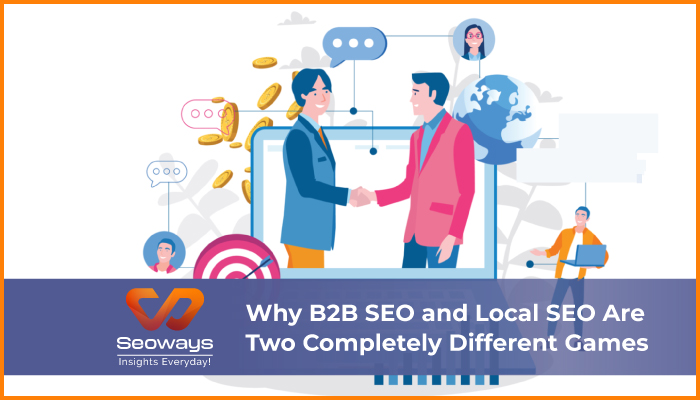
At first glance, SEO looks like SEO. Keywords, content, links, rankings, traffic. Put effort in and results come out. That belief is exactly where most businesses go wrong.
B2B SEO and Local SEO are not just different tactics under one umbrella. They are two entirely different games with different rules, timelines, buyer psychology, and success signals.
Trying to apply Local SEO thinking to B2B is like using a street map to fly an aircraft. It may look familiar, but it will not get you where you want to go.
This article breaks down why these two worlds operate differently, how search intent behaves in each case, and what smart businesses do once they understand the gap.
Search intent is the spine of SEO. Everything else wraps around it.
Local SEO intent is immediate and practical.
B2B SEO intent is strategic and layered.
When someone searches for a local service, they are usually ready to act. There is urgency. Something is broken. Something is needed today or this week. The decision window is short.
B2B searchers behave very differently. They are not in a rush. They are researching, comparing, validating, and sometimes just learning vocabulary. A single buyer rarely makes the final call. Committees do.
This difference alone changes everything from keyword selection to content depth.
Local SEO operates in a compressed timeline.
A typical local search journey looks like this
Search
Compare
Call
Visit
Pay
The entire process may take minutes or a few days.
Because of this, Local SEO prioritizes visibility at the moment of need. Proximity matters. Trust signals matter fast. Convenience wins.
This is why Google Maps, reviews, business hours, photos, and phone numbers dominate local rankings. Content exists, but it plays a supporting role.
If your listing looks credible and close enough, you win.
B2B SEO works on a stretched timeline.
The journey looks more like this
Problem awareness
Education
Internal discussion
Vendor shortlisting
Validation
Budget approval
Purchase
This can take months. Sometimes longer.
The role of SEO here is not to push for a sale. It is to guide thinking. To shape perception. To quietly position a brand as the safest and smartest choice.
This is why long form content, deep explanations, comparison pages, and industry insights matter so much in B2B. You are not chasing a click. You are building confidence over time.
Local SEO keywords are usually obvious.
They include location, service, and urgency.
Dentist near me
Plumber in Erode
Car service open now
These keywords convert because the intent is transactional.
B2B keywords are rarely that direct.
They often sound informational.
How to reduce cloud infrastructure costs
Best ERP software for manufacturing
CRM implementation challenges
Many businesses ignore these because they do not look like buyer keywords. That is a mistake.
In B2B, informational searches are buyer searches in disguise. The deal just happens later.
If your content helps someone explain a solution internally, you are already winning.
Local SEO content needs clarity, not complexity.
Service pages work when they answer simple questions clearly. Who you are, what you do, where you operate, and how to contact you. Long essays are often unnecessary.
B2B SEO demands depth.
Shallow content does not survive scrutiny. Decision makers want evidence of thinking. They want to see that you understand their world better than they do.
This is why B2B content performs better when it explains concepts thoroughly, uses real scenarios, and anticipates objections. It is not about word count. It is about intellectual honesty.
If your content feels like marketing fluff, it dies quietly.
Local SEO trust is visual and social.
Star ratings
Customer photos
Recent reviews
Response to complaints
These are instant trust accelerators. People glance and decide.
B2B trust is slower and more subtle.
Trust comes from
Consistency of messaging
Depth of knowledge
Clear point of view
Mentions in the right places
A flashy website with shallow content does not build B2B trust. A simple site with sharp insights often does.
People in B2B buy confidence, not promises.
Local SEO backlinks are often about relevance and locality.
Links from local newspapers
Chambers of commerce
Local directories
Community sites
Quantity matters less than context.
B2B backlinks act as authority validation.
Links from industry publications
Niche blogs
Research platforms
Technical communities
These links are not just ranking signals. They are perception signals. They tell buyers that others in the ecosystem already take you seriously.
Buying random links hurts more in B2B than in Local SEO. The audience notices.
In Local SEO, conversion is easy to define.
A call
A form fill
A walk in visit
If rankings bring actions, the SEO is working.
In B2B SEO, conversion is delayed and indirect.
Someone may read five articles over six months. Then recommend you internally. Then revisit your site later. Then contact sales.
Attribution becomes fuzzy.
Smart B2B teams stop obsessing over last click conversions and focus on assisted influence. If SEO shortens sales cycles or improves lead quality, it is working.
Local SEO leans heavily on Google controlled assets.
Your business profile often matters more than your website. Updates, reviews, photos, and Q and A activity directly impact visibility.
In B2B SEO, your website is the primary asset.
Search engines and AI tools evaluate your site as a knowledge base. The more coherent and useful it is, the more visibility you earn across platforms.
You are not just optimizing for Google. You are optimizing for how machines summarize expertise.
AI search tools summarize answers instead of listing options.
Local queries still return lists because proximity matters.
B2B queries increasingly return synthesized explanations. The tools choose sources that show clarity, depth, and original thinking.
This means thin B2B content disappears faster than ever. Local SEO still survives on presence and relevance.
If your B2B content does not add something new to the conversation, AI tools ignore it.
Local SEO feeds frontline sales.
Calls come in hot. The job is to respond fast and close.
B2B SEO feeds strategic sales.
Leads come informed. Sometimes skeptical. Sometimes already convinced. Sales teams shift from explaining basics to addressing fit and trust.
When SEO aligns with sales maturity, B2B growth feels effortless. When it does not, friction increases.
Local SEO success metrics are simple.
Map rankings
Call volume
Review growth
Foot traffic
B2B SEO metrics need interpretation.
Content engagement
Repeat visits
Search visibility across topics
Pipeline influence
If you use Local SEO metrics to judge B2B performance, you will kill good strategies too early.
Patience is not optional here.
Many B2B brands copy what works locally.
Short pages
Aggressive calls to action
Keyword stuffing
Over emphasis on quick leads
This creates a mismatch between buyer expectations and brand behavior.
B2B buyers feel rushed and misunderstood. They leave quietly.
The irony is that doing less selling often sells more in B2B.
The moment businesses treat B2B SEO and Local SEO as separate disciplines, results improve.
Budgets get allocated correctly.
Content quality improves.
Sales alignment increases.
AI visibility improves naturally.
The work becomes calmer. More deliberate. More effective.
SEO stops being a tactic and starts becoming infrastructure.
Local SEO is execution heavy.
B2B SEO is thinking heavy.
Both matter. Both are valuable. But they reward different skills.
If you try to run both with the same mindset, one will always underperform.
Understanding this difference is not advanced SEO. It is foundational SEO.
And yet, most businesses learn it the hard way.
| Section Theme | Core Focus | Key Takeaway |
| Search Intent | Buyer mindset | Urgency versus research |
| Content Strategy | Depth and format | Education beats promotion |
| Trust Signals | Credibility drivers | Reviews versus authority |
| Measurement | Success metrics | Immediate actions versus influence |


Request your best quote today!”

With the #1 Digital Marketing Agency!
We specialize in SEO, driving traffic, enhancing online visibility, and transforming markets with innovative strategies.
Seoways LLP,
1st Floor, SKK Complex,
Mohanur Road,
TN – 637001
Skype/Telegram: Seoways
Phone: +91 959 77 00 888