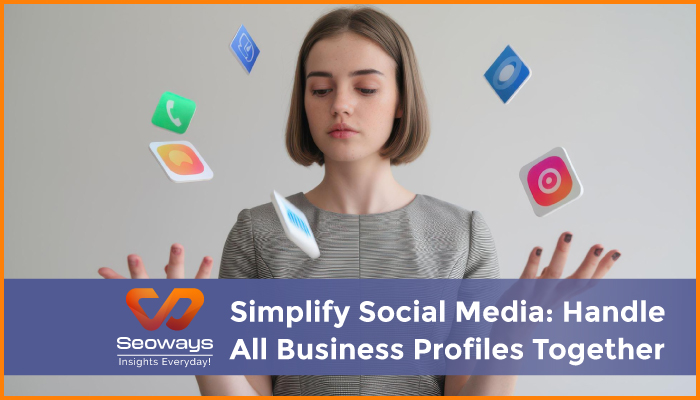
Social media used to be a playground. A place where you could drop a selfie, type a caption that made no sense, and walk away without thinking twice. But for businesses, things changed quickly. Platforms became crowded, algorithms became picky, and suddenly running just one profile felt like juggling a dozen. Now imagine when your brand has to manage Facebook, Instagram, LinkedIn, Twitter (X), YouTube, TikTok — all at the same time.
It can feel like you’re always on a treadmill. Post here, reply there, schedule something over there. And just when you think you’re done, another notification pings. That’s why simplifying social media management is not just a luxury anymore — it’s survival.
I’ve seen small businesses collapse under the weight of scattered profiles. I’ve also seen single founders flourish because they built systems to keep everything together. And in this article, we’ll break down how you can handle all your business profiles together without losing your sanity.
Running a brand in 2025 means you can’t afford to live on just one platform. Each network has its own vibe. LinkedIn is where you shake hands in a digital suit. Instagram is where your visuals tell a story. Twitter (X) is fast-paced and sometimes chaotic. TikTok is where creativity meets attention spans of ten seconds.
That’s good for exposure but bad for your schedule. The problem isn’t the platforms themselves. It’s the fragmentation. Different dashboards, different metrics, different content needs. Suddenly your day becomes about logging in and out, copying captions from a Word file, and praying you didn’t forget to resize that one graphic for Instagram Stories.
When I first worked with a café client, they had five different profiles. Their team was posting randomly, forgetting passwords, and literally reposting Facebook images on LinkedIn. It was messy. Once we streamlined everything into one dashboard, engagement doubled within three months — not because their content got fancier, but because it finally became consistent.
So why should you even bother pulling everything together? Here are the game-changing benefits:
There are platforms that act like mission control for your social media. You connect all your profiles once, and suddenly you can schedule, reply, and analyze from one screen.
Some popular ones include:
When I first started using Buffer for a client’s profiles, it felt like stepping out of chaos into order. No more alarms on my phone to remind me to post. I could plan content a week in advance and actually enjoy creating instead of rushing.
Here’s the big fear: if you automate too much, your brand will feel robotic. Nobody wants to talk to a machine. The trick is to use simplification tools for structure, not for voice.
Back in 2021, a friend of mine started freelancing as a graphic designer. She built up a client list quickly, but she struggled with one thing — marketing herself. Every day she would manually post on Instagram, then log into LinkedIn, then jump on Twitter. She told me once she had 13 browser tabs open just for social media.
It worked for a while, but soon she stopped posting because it became overwhelming. Her brand went quiet. Clients stopped discovering her. Then she switched to a unified tool, started planning weekly, and suddenly her profiles came alive again. Today, she books clients from posts she scheduled weeks in advance.
The lesson? Tools don’t just save time. They save businesses from burnout.
Let’s map this out in a way you can copy-paste into your own process:
I worked with a restaurant in my city that had amazing food but zero digital consistency. They had a Facebook page, an Instagram account, and occasionally someone posted on Twitter. Nothing matched, and half the time, the photos were just random snapshots from the staff’s phones.
We introduced a simple workflow: all content was batched on Mondays, scheduled for the week, and then monitored daily for replies. Within six months, they saw a 70% increase in online orders because customers were constantly reminded of them across multiple platforms. And the owner? He spent half the time he used to spend on social media.
Simplifying social media is less about tools and more about mindset. You’re not trying to be everywhere all the time. You’re trying to be present consistently without draining yourself.
Think of it like a gym routine. If you go randomly, you’ll quit. But if you set fixed days and follow a plan, you actually enjoy the process and see results. Social media works the same way.
Running multiple social media profiles doesn’t have to feel like a storm you’re trapped in. With the right tools, batching strategies, and mindset, you can turn that chaos into clarity. And the best part? You don’t lose the personality of your brand. You gain time, consistency, and results.
If you’re tired of jumping between tabs and apps, maybe today’s the day to simplify. Your future self — and your business growth — will thank you.
| Section | Key Idea | Actionable Takeaway |
| Why Multiple Profiles Feel Like a Maze | Platforms create fragmentation and stress | Recognize the problem is structure, not content |
| Core Benefits of Simplifying Social Media | Consistency, time-saving, clarity | Build trust with efficiency |
| Tools That Bring It Together | Hootsuite, Buffer, Sprout Social, Zoho | Test a tool and pick one |
| How to Simplify Without Losing Personality | Batch, schedule, repurpose, adapt tone | Automate structure, not human voice |
| Personal Story & Real Examples | Freelancer and restaurant case studies | Tools save time and prevent burnout |
| Practical Steps | Audit, choose, schedule, engage, track | Set up a workflow you’ll stick to |
| Mindset Shift | From chaos to clarity | Treat it like a routine, not a chore |


Request your best quote today!”

With the #1 Digital Marketing Agency!
We specialize in SEO, driving traffic, enhancing online visibility, and transforming markets with innovative strategies.
Seoways LLP,
1st Floor, SKK Complex,
Mohanur Road,
TN – 637001
Skype/Telegram: Seoways
Phone: +91 959 77 00 888