
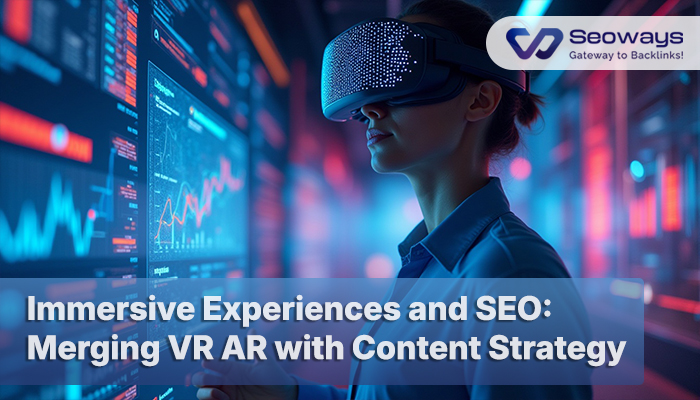
The internet is never still. Just when you think you have figured out the rules of the game, something new shows up. I remember the first time I put on a VR headset. The world around me blurred and suddenly I was standing in a virtual museum. I reached out my hand, tried to touch the walls, and laughed out loud when my fingers hit the air instead. It was playful, a little clumsy, and yet unforgettable. That moment made me realize this is not just tech for gamers. This is the future of how we experience content.
So now the question is clear. How does this connect to SEO? Can immersive experiences like VR and AR actually influence content strategy and rankings? And what happens when your website is no longer just words and images but a living digital space people can step into?
Let us walk through it.
Immersive experiences are more than just flashy visuals. VR places users inside an environment, cutting off the outside world. AR overlays information on top of real life surroundings. Think of Pokémon Go, or even simple Instagram filters. They merge digital and physical in a way that feels natural, sometimes even magical.
From an SEO perspective, immersive content is the next layer. Search engines are designed to reward relevance, engagement, and usefulness. If VR and AR can make users stay longer, interact deeper, and remember the experience, then they naturally align with what search engines want to deliver.
Let me tell you a small story. Years back I managed a blog where the average time on page was less than a minute. We tried long form content, images, even videos. Results improved, but not dramatically. Then we tested an interactive infographic where readers could move sliders and see real time data change. The bounce rate dropped instantly, time on page doubled.
That was my first clue that engagement is not just a vanity metric. It is central to SEO. VR and AR are like that interactive infographic but on steroids. If someone can “walk” through your content or “see” how a product fits in their home, they will not just skim, they will explore. Search engines notice these signals.
Of course it is not all roses. Search engines are built to crawl text, links, and structured data. VR and AR often use heavy media formats not easily read by bots. If your content is trapped inside a 3D environment without metadata, Google may not understand it.
I once worked with a small company that created a stunning VR demo of their product. But their website traffic flatlined because the experience was locked inside a Unity file with no alt text, schema, or descriptive content. Lesson learned: immersive does not replace fundamentals. Always pair it with crawlable text, captions, and context.
SEO has always been a balance. On one side, you want human friendly content. On the other, search engine friendly structure. VR and AR exaggerate this tension. Too much focus on flashy 3D with no crawlable layers and you vanish from search. Too much text with no immersion and you bore your audience.
The sweet spot is merging both. For instance, a museum using VR tours can provide detailed transcripts, metadata, and summaries along with the immersive content. This gives search engines something to digest while humans enjoy the wow factor.
One underestimated aspect of SEO is authority. Not just domain authority as a metric but brand authority in the minds of users. When a brand offers a cutting edge AR or VR experience, people talk about it. They share it. Bloggers write reviews. News sites cover the innovation. All these lead to backlinks, social signals, and citations.
I remember a campaign by a shoe company that let users try sneakers on virtually. The campaign went viral not because the shoes were extraordinary but because the experience was novel. Their organic traffic spiked for months. That is the SEO halo effect of immersive content.
AI now powers search intent understanding, and it also plays a role in immersive SEO. AI can generate adaptive environments where the content changes depending on what the user needs. For example, if someone is researching fitness equipment, an AI driven VR experience could highlight treadmills for one user and weights for another.
This personalization is a goldmine for SEO because it increases relevance. The closer your content matches intent, the higher your chance of ranking well.
For many marketers, VR and AR sound futuristic and expensive. But you do not need a massive budget to start. Here are simple ways to explore:
The point is not to wait for the future but to start small and learn how users respond.
It is tempting to chase shiny tech. But early adoption has risks. Development costs can eat your budget, and user adoption might be slow. Years back I saw a company spend heavily on a VR app that required expensive headsets. Their target audience never adopted it, and the project died quietly. The lesson here is simple: match your tech investment to your audience readiness.
As VR headsets become cheaper and AR is built into phones, immersive content will stop being a novelty and become normal. Search engines will likely adapt with better ways to index and rank immersive assets. SEOs who start experimenting now will be ahead of the curve.
I sometimes wonder what browsing the web will feel like in ten years. Maybe instead of scrolling articles, you will be walking through knowledge hubs. Instead of product photos, you will test products in your living room with AR. And the websites that prepare for this shift today will own tomorrow’s rankings.
Immersive experiences are not a replacement for SEO but an expansion of it. They add depth, engagement, and memorability. The challenge is making sure they also remain visible to search engines. If you can balance technical SEO with user delight, you can ride this wave instead of being drowned by it.
And honestly, that is the fun part of SEO. It keeps changing. It keeps us on our toes. Just like my clumsy first VR demo, it is awkward at times, but exciting beyond words.
| Section | Title | Key Takeaway |
| 1 | Understanding Immersive Experiences | Basics of VR and AR in content |
| 2 | The Connection Between Engagement and Rankings | Engagement boosts SEO signals |
| 3 | Practical Use Cases of VR and AR | Real life brand examples driving SEO |
| 4 | SEO Challenges with Immersive Content | Why crawlability still matters |
| 5 | User Experience vs Technical SEO | Balance humans and search engines |
| 6 | How Immersive Content Builds Authority | Backlinks and buzz through innovation |
| 7 | The Role of AI in Immersive SEO | Personalization improves relevance |
| 8 | Practical Steps for SEOs Today | Simple ways to start experimenting |
| 9 | Risks of Going Too Early | Avoid over investing too soon |
| 10 | Where This Could Head | Long term future of immersive SEO |
| 11 | Final Thoughts | Immersion expands but never replaces SEO |


Request your best quote today!”

With the #1 Digital Marketing Agency!
We specialize in SEO, driving traffic, enhancing online visibility, and transforming markets with innovative strategies.
Seoways LLP,
1st Floor, SKK Complex,
Mohanur Road,
TN – 637001
Skype/Telegram: Seoways
Phone: +91 959 77 00 888