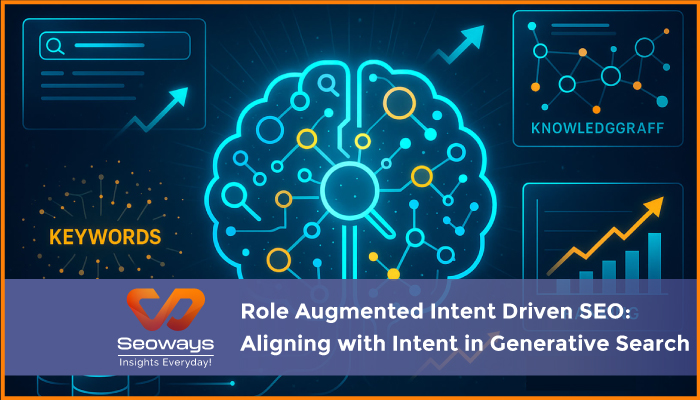
The rise of generative AI models has reshaped the SEO landscape. Traditional keyword based strategies are no longer enough. Enter Role Augmented Intent Driven SEO, a methodology that aligns content with the specific intent behind user queries while considering the context in which AI interprets and generates responses. This approach enables brands to connect more meaningfully with audiences, enhance visibility and maintain relevance in generative search environments.
Intent refers to the underlying purpose or goal behind a user query. In generative search, AI models analyze context, user behavior and semantics to determine the intent, then provide answers accordingly. Optimizing content for intent rather than solely for keywords ensures that responses generated by AI are relevant, accurate and actionable.
Intent can be classified into informational, navigational and transactional. Informational intent is when users seek knowledge, navigational is when they want a specific website or resource, and transactional is when they intend to make a purchase or complete an action.
Role augmentation refers to understanding the role your content or brand plays in satisfying a user query. Instead of just providing information, content must consider the user journey and context. For example, a product review page may serve as a guide, comparison tool or influencer recommendation depending on user intent.
By identifying these roles, content can be structured to address multiple facets of user intent, increasing the likelihood that AI models will reference or use it when generating responses.
Map your content to specific user intents. Understand the questions, pain points and goals of your audience. Structured content that addresses multiple aspects of intent enhances discoverability in AI search.
Determine the role your content should play in the context of a query. Is it educational, advisory, comparative or transactional? Aligning your content role with user intent improves relevance and engagement.
In generative search, semantic understanding is critical. Use natural language, related terms and contextually relevant phrases. This enables AI to interpret your content correctly and increase the chances of it being included in AI generated responses.
Content must be organized with clear headings, subheadings, bullet points and tables where applicable. Readable and scannable content ensures AI models can parse it easily while providing a positive user experience.
Cite credible sources, provide evidence, and maintain accuracy. AI models prioritize authoritative content. Building trust through transparent information strengthens the likelihood of being referenced.
Group related content around core topics to create comprehensive resources. Clusters help AI models understand the breadth and depth of your content and enhance semantic relevance.
Use Q and A sections to directly address common queries. AI models often extract answers from such structured formats, improving chances of inclusion in generated responses.
Illustrate points with examples or case studies. Contextualized content allows AI to generate richer, more actionable responses.
AI models evolve and so does user intent. Regularly review and update content to ensure alignment with current trends, queries and preferences.
While role augmented intent driven SEO focuses on generative search, traditional SEO practices like backlinks, page speed, and meta optimization remain important. Combining both strategies ensures comprehensive visibility.
User intent can be nuanced. Misinterpreting it may result in irrelevant content. Continuous research and analytics are essential.
Content must satisfy both AI models and human readers. Over optimization can reduce clarity and engagement.
As AI increasingly cites sources, ensuring content credibility and accuracy is crucial. Errors or misleading information can damage brand trust.
Generative AI tools constantly update. Strategies must adapt to changes in how AI interprets queries and prioritizes content.
Brands that have embraced intent driven SEO see better engagement, improved relevance and increased visibility in generative search results. By mapping content to user intent, defining roles and structuring information effectively, businesses position themselves as authoritative sources that AI models consistently reference.
Organizations that ignore intent risk producing content that is technically optimized but irrelevant to user needs, resulting in reduced visibility, engagement and potential authority loss in AI generated outputs.
As generative AI adoption grows, aligning with user intent will become a central pillar of SEO strategy. Marketers will need to focus on understanding evolving queries, defining the role of content, and ensuring semantic clarity. Role augmented intent driven SEO is not just a trend but a necessary evolution in digital marketing for the AI age.
Role augmented intent driven SEO bridges the gap between user intent and generative AI capabilities. By understanding the underlying goals behind queries, defining the role of content, and optimizing for semantic clarity, marketers can ensure their content is both useful to users and discoverable by AI models. This strategic alignment enhances visibility, authority and engagement in the rapidly changing digital landscape.
| Section | Key Idea | Takeaway |
| Understanding Intent | User goals and query purpose | Align content with underlying intent |
| Role Augmentation | Define content role in context | Increase relevance and engagement |
| Key Components | Intent mapping, semantic optimization | AI friendly and human readable content |
| Implementation Strategies | Clusters, Q and A, examples | Maximize inclusion in AI responses |
| Challenges | Nuanced intent, balancing readability | Ensure accuracy and authority |
| Real World Perspective | Effectiveness in practice | Enhanced visibility and engagement |
| Future Outlook | AI and evolving queries | Role augmented intent driven SEO becomes essential |


Request your best quote today!”

With the #1 Digital Marketing Agency!
We specialize in SEO, driving traffic, enhancing online visibility, and transforming markets with innovative strategies.
Seoways LLP,
1st Floor, SKK Complex,
Mohanur Road,
TN – 637001
Skype/Telegram: Seoways
Phone: +91 959 77 00 888