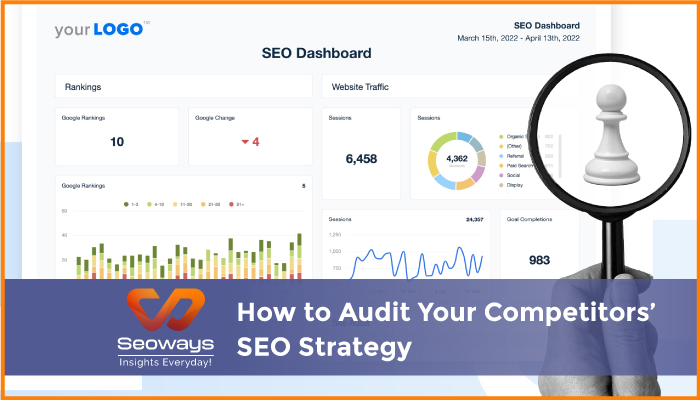
Competition in SEO is a bit like playing chess. You don’t just focus on your next move—you watch your opponent’s every step, study their tactics, and figure out where their strengths and weaknesses lie. The same is true online. If you want to win in search, you need to understand what your competitors are doing, why they are ranking, and how you can do it better.
Auditing your competitors’ SEO strategy is not about copying them. It’s about learning what works in your industry, spotting gaps, and using those insights to create your own winning plan.
In this guide, I’ll walk you through the exact process of analyzing competitors’ SEO, with practical steps, real-life examples, and the kind of insights you can put into action today.
The truth is, your competitors are probably ranking for the same keywords you’re chasing. They’re getting the traffic, leads, and customers you’d like to have. By studying them, you uncover the blueprint of what search engines value in your niche.
Back when I worked with a small ecommerce store, we were struggling to beat two big players. Our instinct was to publish more blog posts, but traffic barely moved. Only when we studied our competitors did we realize they weren’t winning with quantity—they were winning with deep, detailed product guides and high-quality backlinks. That changed our strategy and tripled our traffic in six months.
Not every business in your industry is a true competitor in SEO. Sometimes the ones stealing your traffic aren’t even selling the same product—they just create content that attracts the audience you want.
Start with a few checks:
When I first audited competitors for a SaaS client, we thought other SaaS companies were the rivals. But actually, it was comparison blogs that were ranking above everyone else. That insight reshaped our entire content strategy.
Keywords are the foundation of SEO. By looking at what your competitors target, you can find opportunities for yourself.
One quick win I’ve used: look for keywords where competitors rank between positions 5 and 15. If they’re not fully optimized, you can swoop in with stronger content and overtake them.
Content is where SEO really plays out. Study not just what your competitors write about, but how they write it.
For example, I once audited a competitor who had dozens of articles ranking for “digital marketing tools.” But they only listed tools with short descriptions. We built a mega guide with real screenshots, pros and cons, and personal notes. Within weeks, our guide outranked theirs and became our top traffic driver.
Even the best content won’t perform if the basics aren’t right. Look at your competitors’ on-page SEO.
Sometimes you’ll notice small gaps. For instance, a competitor may have a solid blog post but no meta description that sparks clicks. That’s your opening to create a better version.
Backlinks are like votes of confidence. The more quality sites linking to your competitor, the more authority they get.
Here’s a personal story. I once found that a competitor in the travel space had dozens of backlinks from local tourism boards. That inspired us to pitch our own content to those same boards. Within months, we built links that not only boosted rankings but also brought real referral traffic.
Technical SEO is the invisible backbone. If your competitors have fast, well-structured sites, that gives them an edge.
Check:
One client had better content than all their rivals but lost rankings because their site was painfully slow on mobile. A technical SEO audit revealed the issue, and fixing it brought them back to page one.
Search engines don’t just care about keywords and links—they measure how users interact with a page.
I once noticed that a competitor’s site was filled with popups and autoplay videos. Users hated it. By offering a cleaner, distraction-free design, we won more engagement and eventually outranked them.
In 2025, SEO overlaps heavily with brand signals. Competitors with strong branding and active social channels tend to build authority faster.
This doesn’t mean you need to copy them, but you should know how they’re building awareness outside of search engines.
SEO is not static. Competitors change tactics, publish new content, or earn new backlinks every month.
Set up alerts with tools like Ahrefs Alerts or Google Alerts. Each week, scan what your competitors published or what new links they earned. This helps you react quickly instead of playing catch-up months later.
I make it a personal routine to check competitor updates every Friday afternoon. It’s like a quick stock market check, except for SEO.
An audit is only useful if you apply what you learn.
The key is not to copy but to outdo. Think of it like running a race—you don’t just match your rival’s pace, you find a way to sprint past them.
Auditing your competitors’ SEO strategy is one of the smartest moves you can make in 2025. It gives you clarity on where the bar is set in your niche, what gaps exist, and how you can rise above.
Remember, competitors aren’t enemies—they’re teachers. Every time you study their wins and losses, you learn how to sharpen your own strategy. With consistent analysis and action, you’ll find yourself not just catching up but eventually setting the pace for others to follow.
| Section | Key Takeaways | Action Steps |
| Why Audit Competitors | Learn from rivals’ strengths and gaps | Use insights, not imitation |
| Identify Competitors | Not always direct business rivals | Check Google and tools |
| Keyword Strategy | Spot traffic-driving keywords | Target gaps and weak spots |
| Content Analysis | Quality and depth matter | Build stronger guides |
| On-Page SEO | Titles, headers, schema | Optimize basics better |
| Backlink Profile | Links equal authority | Earn from same sources |
| Technical SEO | Site speed and mobile | Audit and fix issues |
| User Signals | Engagement drives rankings | Improve design and UX |
| Branding & Social | Brand signals influence SEO | Monitor mentions and activity |
| Regular Monitoring | SEO is ongoing | Track weekly updates |
| Action Plan | Turn data into results | Outperform, don’t copy |


Request your best quote today!”

With the #1 Digital Marketing Agency!
We specialize in SEO, driving traffic, enhancing online visibility, and transforming markets with innovative strategies.
Seoways LLP,
1st Floor, SKK Complex,
Mohanur Road,
TN – 637001
Skype/Telegram: Seoways
Phone: +91 959 77 00 888