
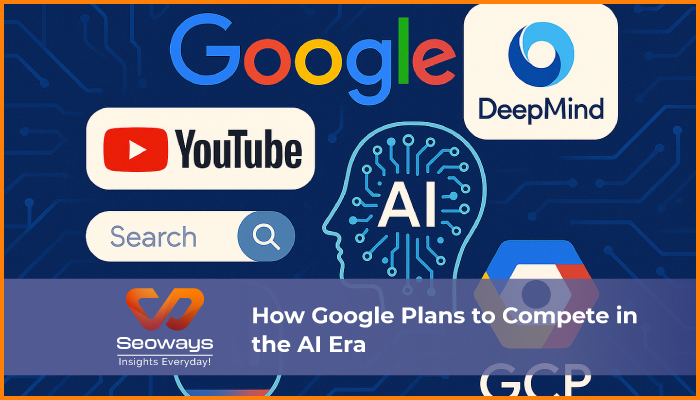
The AI era is here, and it is changing everything about how we search, discover, and consume information. Traditional search engines are no longer just about links and keywords. They are about understanding context, intent, and conversation. And at the heart of this transformation is Google, a company that has defined search for over two decades.
But how does Google plan to compete in this era dominated by generative AI, chat assistants, and intelligent recommendation engines? The answer is multi-layered, strategic, and quietly aggressive.
This article explores Google’s plans, tactics, and innovations to remain at the top in 2026, both in AI-powered search and broader technology ecosystems.
Generative AI tools, chatbots, and AI-driven discovery platforms have changed user expectations. People no longer want ten links and snippets. They want answers, summaries, context, and insight—fast, accurate, and interactive.
This shift is already impacting search behavior. Users are increasingly relying on AI assistants for research, decision-making, and even creative tasks. Traditional search, while still essential, risks becoming a secondary step if Google does not adapt.
Google understands this. The stakes are enormous. Losing relevance in search traffic means losing its main revenue source—ads. And in 2026, AI-driven platforms are already siphoning attention, engagement, and monetization opportunities from traditional search.
Google’s approach to competing in the AI era can be understood in three layers: Search innovation, AI product ecosystem, and data infrastructure.
Google Search has been evolving quietly but aggressively. Some of the key initiatives include:
These innovations show that Google is not reacting to AI trends; it is actively shaping them.
2. AI Product Ecosystem
Beyond search, Google is expanding its AI footprint across consumer and enterprise products:
3. Data Infrastructure and AI Ethics
AI is only as good as the data it learns from. Google’s competitive edge lies in its massive, diverse, and real-time data streams: search queries, YouTube engagement, Maps usage, and Android telemetry.
In addition, Google is heavily investing in AI governance, bias detection, and ethical AI. In 2026, regulatory scrutiny is intense. Companies that can deploy AI responsibly while retaining performance will dominate, and Google wants to be that company.
By now, it is clear Google is not just worried about AI in search. Competitors like OpenAI, Microsoft, and emerging AI startups are redefining the playing field.
Google is responding strategically. It is combining AI-first experiences with its massive distribution network—Search, Gmail, YouTube, Android, and Cloud—to create a defensible moat. While competitors might have strong AI models, Google has reach, data, and ecosystem synergy that is hard to match.
Advertising remains Google’s primary revenue driver, and AI changes the game. Users interacting with chat assistants or AI summaries may skip traditional ads entirely. Google is innovating in response:
The shift from keyword-based to AI-based advertising ensures Google’s revenue remains protected while enhancing user experience.
Even with resources, Google faces challenges in the AI era:
Despite these challenges, Google’s scale, data, and AI talent give it a strong chance to navigate these obstacles.
By 2026, Google is no longer just a search engine. It is an AI platform. Everything—from Maps to Gmail, Drive to Cloud—is being infused with AI intelligence. The goal is to create a network effect:
The more users interact with Google AI, the smarter it becomes, which increases engagement, loyalty, and revenue. This feedback loop could make Google AI the default choice across productivity, search, and discovery.
Google is also exploring AI APIs and developer platforms, making it easier for third parties to integrate its AI capabilities. By doing this, Google extends its reach beyond its products, embedding its AI into countless external applications.
What does this mean for everyday users and businesses?
Google’s strategy is about controlling the AI narrative while maintaining trust, transparency, and accessibility. Companies that align with this ecosystem will have a competitive advantage.
The AI era is not a threat to Google; it is an opportunity. But the company must continue to innovate while managing trust, ethics, and user expectations.
In 2026, Google is betting on three things: ecosystem dominance, AI-first product design, and data intelligence. If it executes well, it can remain the central hub of information, productivity, and AI-powered discovery for the foreseeable future.
The competition is fierce, but Google’s approach is strategic, deliberate, and well-resourced. For businesses, users, and developers, understanding this evolution is crucial because it will dictate where AI-powered attention, traffic, and engagement flow in the coming years.
| Section | Focus Area | Key Takeaways |
| AI Disruption Overview | Why AI matters to Google | Changing search behavior and user expectations |
| Google’s AI Layers | Search innovation, AI ecosystem, data infrastructure | Conversational search, Workspace AI, ethical AI |
| Competition Landscape | Microsoft, OpenAI, startups | Strategic positioning and ecosystem moat |
| Ads and Monetization | Contextual and AI-driven ads | Protecting revenue while improving user experience |
| Challenges & Future | Public trust, regulation, ecosystem fragmentation | Becoming an AI platform, not just a search engine |
| Implications | Users, businesses, developers | SEO, advertising, integration strategies |


Request your best quote today!”

With the #1 Digital Marketing Agency!
We specialize in SEO, driving traffic, enhancing online visibility, and transforming markets with innovative strategies.
Seoways LLP,
1st Floor, SKK Complex,
Mohanur Road,
TN – 637001
Skype/Telegram: Seoways
Phone: +91 959 77 00 888