
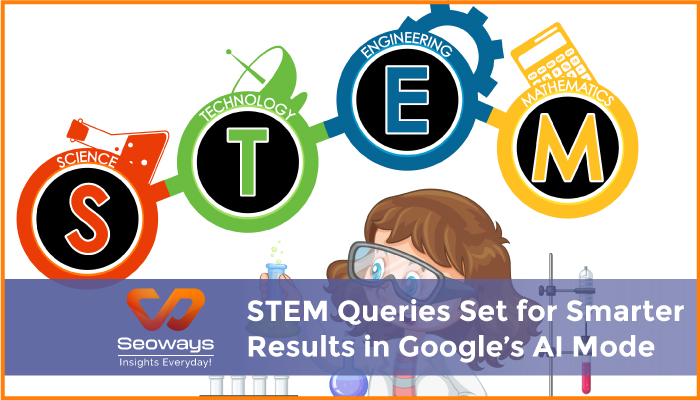
The world of search is changing in ways we have never seen before. The launch of Google’s AI mode has created a shift in how queries are understood, processed, and answered. At the center of this change lies STEM queries. Science, Technology, Engineering, and Mathematics are not just academic subjects anymore. They represent a large part of online learning, professional research, and problem solving.
As someone who has spent countless hours on Google searching for answers to coding problems, engineering formulas, or scientific research papers, I can already see how the quality of results is moving towards clarity and precision. This is not a minor upgrade. It is a complete shift in how Google delivers value to people who search for complex knowledge.
This article explores why STEM queries are gaining special attention in Google’s AI mode, how results are getting smarter, and what it means for learners, professionals, and businesses.
Not all searches are equal. When you search for the best pizza in your city, the results depend on local reviews and ratings. But when you search for the formula of quantum entanglement or the latest methods in nanotechnology, you need accurate, structured, and reliable results.
STEM queries have always been harder for search engines to answer because they involve formulas, academic references, technical terminologies, and context-specific solutions. Many times I used to get frustrated because instead of a straight answer, I had to dig through pages of academic PDFs or scattered blog posts.
With AI mode, Google is learning to interpret STEM queries in a structured way. It understands not just keywords but the intent behind the question. That is the real game changer.
AI mode in Google does not just display links. It tries to act like a teaching assistant. Ask a math-related question and instead of just a list of websites, you get step-by-step solutions. Search for an engineering problem and you see contextual explanations, diagrams, and references to standard sources.
AI is able to do this because it can process structured data, recognize equations, and learn from verified academic sources. While in the past we had to rely on third party platforms like Wolfram Alpha for solving equations or scientific calculators, now Google is directly merging that capability into search.
In my own experience, I once searched for a complex trigonometry proof while preparing content for a project. Earlier, I would have opened multiple math help forums and checked answers by different contributors. Now, AI mode gave me the clean steps in seconds. That is when I realized how powerful this shift is.
Students stand to gain the most. Learning STEM subjects has always been resource heavy. You either needed a good tutor or endless hours searching for the right material online. Google AI mode acts like a 24×7 assistant that simplifies information without dumbing it down.
For example, a high school student asking about the difference between velocity and acceleration now gets more than just definitions. They see real life examples, motion diagrams, and practical explanations that make the concept stick.
Researchers too are seeing improvements. Instead of browsing through 50 academic papers, AI can surface summarized insights with references that save valuable time. This not only accelerates learning but also opens doors for more innovation.
Engineers, data scientists, and medical professionals rely heavily on search for quick references. With AI powered STEM results, the efficiency is remarkable.
Imagine being a software engineer stuck with a syntax error in Python. AI mode does not just show you a Stack Overflow thread anymore. It gives you the corrected code snippet, explains why your error happened, and offers an alternative solution.
In another case, a mechanical engineer searching for stress analysis methods in materials does not just find academic definitions but also simulation examples and case studies.
This saves hours of trial and error and helps professionals focus on execution rather than endless searching.
While the progress is exciting, challenges remain. AI models sometimes oversimplify complex theories. A physics concept explained in a casual tone might miss the depth required for advanced learners. Another issue is trust. Students may start depending entirely on AI responses without cross checking original academic sources.
I faced this myself while checking a math formula where AI gave me the wrong sequence of steps. It looked convincing but turned out to be misleading. That is why human validation will always remain important.
Another concern is bias. STEM research is global but sometimes AI gives prominence to western sources while ignoring equally important research from other parts of the world. Fixing this requires a balance between verified data and diverse perspectives.
Looking ahead, Google’s AI mode will not just answer STEM queries but also personalize them. Imagine asking a physics problem and the AI explains it based on whether you are a school student, an undergraduate, or a professional researcher.
Visual explanations will also become more interactive. Complex chemical reactions could be explained with animated 3D models instead of plain text. Coding questions might come with interactive sandbox environments where you can test the code directly from search.
This personalized, interactive approach will redefine not just how we search but how we learn.
It is easy to think that STEM search improvements only benefit students and researchers. But businesses have a lot to gain too. Companies in education, technology, healthcare, and engineering can use this trend to create AI friendly content that answers STEM queries directly.
For instance, an EdTech company offering online physics courses can structure its content in a way that AI mode picks it up as the top explanation. A software company can publish simplified technical blogs that AI highlights when users search for programming help.
By aligning with AI optimized STEM content, businesses can increase their visibility and authority in niches where accuracy matters most.
As someone who has used search engines for years to solve both simple and complex problems, I see STEM queries as the real test for Google’s AI mode. If Google can get these right, then trust in AI search will grow stronger.
This is not just about faster answers. It is about smarter answers that help students learn better, professionals work faster, and businesses gain visibility in technical domains.
We are entering an era where Google is not just a search engine but a knowledge partner. And STEM queries are at the heart of this transformation.
| Section | Key Points |
| Introduction | Shift in Google AI mode focusing on STEM queries |
| Why STEM Queries Matter | Importance of accuracy in technical and academic searches |
| Role of AI | Smarter contextual answers with equations, diagrams, and explanations |
| Students and Researchers | Simplified learning and quicker research insights |
| Professionals | Practical benefits for engineers, coders, and medical experts |
| Challenges | Risk of oversimplification, errors, and biased sources |
| Future of STEM Learning | Personalized, interactive, and visual explanations |
| Business Relevance | Opportunity for EdTech, technology, and research driven companies |
| Final Thoughts | STEM queries show how AI mode will redefine search and learning |


Request your best quote today!”

With the #1 Digital Marketing Agency!
We specialize in SEO, driving traffic, enhancing online visibility, and transforming markets with innovative strategies.
Seoways LLP,
1st Floor, SKK Complex,
Mohanur Road,
TN – 637001
Skype/Telegram: Seoways
Phone: +91 959 77 00 888