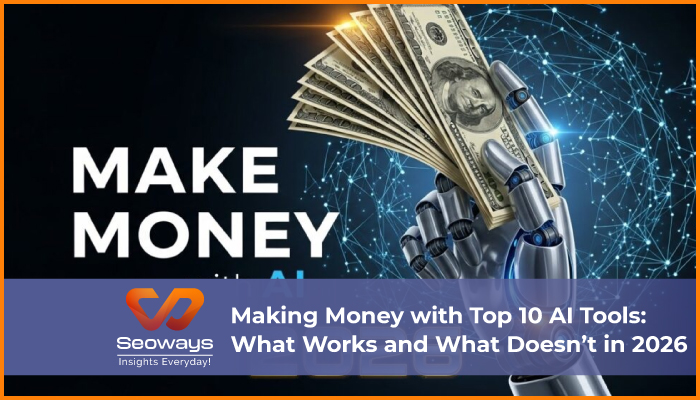
AI is no longer a shiny new toy. In 2026, it is infrastructure. It quietly runs businesses, replaces repetitive work, speeds up decision making, and in many cases, creates money while people sleep. But here’s the uncomfortable truth most blogs avoid saying out loud.
Not all AI tools make money.
Some help you move faster. Some help you look smarter. Only a handful actually help you generate revenue in a repeatable way. The difference between success and disappointment is not the tool itself. It is how the tool is used, positioned, and integrated into a real business model.
This article breaks down the top 10 AI tools people are using to make money in 2026, what genuinely works, what usually fails, and why most users never cross the income line. No hype. No fantasy dashboards. Just practical clarity.
Large language models are still the backbone of AI monetization. But the way people make money with them has changed.
What works now is not generic content generation. That era is gone. Search engines, AI overviews, and users can smell shallow content instantly. What works is applied intelligence.
People are earning consistently by building niche specific solutions on top of language models. Customer support copilots trained on internal data. Proposal generators customized for a single industry. Sales scripts adapted in real time based on lead behavior.
What does not work anymore is mass blogging, low effort freelancing, or reselling prompts. The market is saturated and margins are thin. If your output looks like it could be written by anyone, it will be priced like it too.
The money comes when the AI is invisible and the outcome feels human.
Visual AI still prints money, but only for people who understand branding and storytelling.
Designers who repositioned themselves as creative directors rather than image generators are thriving. They use AI to prototype fast, explore concepts, and deliver polished brand assets at scale. Businesses pay for speed and taste, not pixels.
Where people fail is selling raw images. Stock style AI images are everywhere. Clients do not pay premium rates for something they can generate themselves in thirty seconds.
The real income comes from packaging visuals into brand kits, ad creatives, pitch decks, and product mockups that solve a business problem.
Short form video continues to dominate attention. AI video tools help creators and businesses produce more content with fewer resources.
What works is content systems. Faceless channels, educational explainers, localized ads, and product demos generated consistently. People making money here think like publishers, not creators.
What does not work is random viral chasing. AI videos without a niche, message, or distribution plan fade quickly.
The winning approach is repeatable formats. Same structure, same hook style, same audience, different message. AI just makes it scalable.
Synthetic voice has matured. It now sounds natural enough to power podcasts, audiobooks, customer support, and training content.
The money is in utility. Businesses pay for narrated courses, onboarding material, and internal documentation. Creators monetize audiobooks and private content libraries.
What does not work is generic voice selling. Nobody pays just for a voice anymore. They pay for clarity, tone, and delivery aligned to their brand.
AI voice is a multiplier, not a product.
This category quietly creates some of the highest income streams.
Developers use AI coding tools to ship faster, debug smarter, and maintain systems with fewer people. Freelancers deliver projects in half the time. Agencies improve margins without raising prices.
Where people go wrong is trying to sell code generation itself. Clients do not care how code is written. They care if the product works, scales, and stays secure.
AI makes good developers dangerous and bad developers irrelevant.
SEO did not die. It evolved.
AI SEO tools that analyze intent, structure content, and optimize for human clarity still help generate revenue. Agencies use them to improve consistency and reduce manual effort.
What does not work is automated link building, spun content, and fake authority. Those tactics collapse faster in 2026 than ever before.
The tools work when paired with strategy, brand signals, and real expertise. Without that, they amplify failure.
AI driven outreach tools help teams research prospects, personalize messaging, and follow up intelligently.
What works is controlled automation. Human reviewed messaging, smart segmentation, and timing based on buyer behavior.
What fails is volume abuse. Mass AI outreach burns domains, reputations, and opportunities.
The teams making money treat AI like a junior assistant, not a spam cannon.
Data is overwhelming. AI makes it usable.
Companies pay for insights, not dashboards. Consultants who use AI to turn messy data into clear recommendations are in demand.
What does not work is generic reporting. Charts without context do not create value.
AI shines when it answers one simple question. What should we do next.
Automation tools quietly power many profitable businesses.
Agencies build internal workflows. Solopreneurs run entire operations with minimal staff. E commerce sellers automate support, inventory alerts, and marketing.
What fails is over automation. Broken workflows destroy trust fast.
The money is in boring reliability. Systems that run without drama.
This is where the biggest upside lives.
Micro SaaS tools powered by AI solve very specific problems. Proposal scoring. Resume screening. Content moderation. Industry specific research.
What does not work is building broad tools with no differentiation. Giants win that game.
Small focused AI products win by being essential to a narrow audience.
Across all tools, the pattern is clear.
People who make money with AI do not sell AI. They sell outcomes. Speed. Clarity. Revenue. Reduced effort.
AI is invisible in the final value proposition. That is why it works.
They chase tools instead of problems. They copy surface level tactics. They avoid distribution and sales.
AI rewards people who understand business fundamentals. It exposes those who do not.
Ask three questions.
Does this solve a painful problem.
Can someone pay for this repeatedly.
Can I distribute this better than others.
If the answer is no, the tool is a distraction.
AI will keep getting cheaper and better. The advantage will move away from access and toward judgment.
Those who win will combine AI speed with human taste, ethics, and decision making.
AI is not replacing people. It is replacing excuses.
| Section | Key Tool Category | Revenue Reality |
| Language Models | ChatGPT and LLMs | High when specialized |
| Visual AI | Image Generation | Medium with branding |
| Video AI | Short Form Systems | High with consistency |
| Voice AI | Audio Content | Medium with utility |
| Coding AI | Dev Assistants | Very high for builders |
| SEO AI | Optimization Tools | High with strategy |
| Sales AI | Outreach Systems | Medium with restraint |
| Data AI | Analytics | High with insights |
| Automation | Workflow Tools | High with stability |
| Custom AI | Micro SaaS | Very high niche based |


Request your best quote today!”

With the #1 Digital Marketing Agency!
We specialize in SEO, driving traffic, enhancing online visibility, and transforming markets with innovative strategies.
Seoways LLP,
1st Floor, SKK Complex,
Mohanur Road,
TN – 637001
Skype/Telegram: Seoways
Phone: +91 959 77 00 888