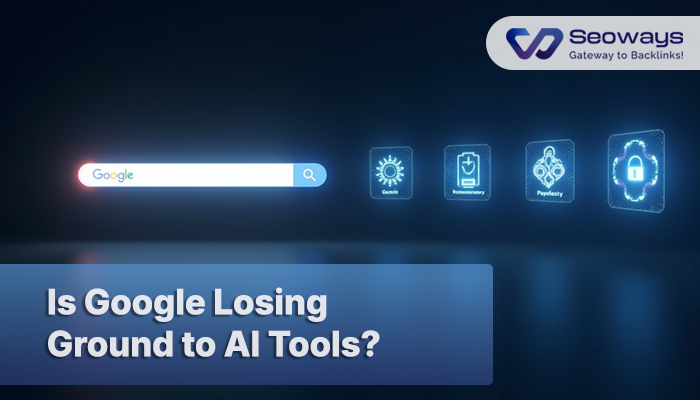
For as long as I can remember, Google has been the front door to the internet. You wanted an answer, you typed it in, and Google gave you ten blue links. That simple model built an empire. But lately, I can’t help but wonder if that empire is starting to crack. Everywhere I look, people are asking questions not to Google, but to AI tools like ChatGPT, Gemini, Claude, and Perplexity.
I asked a college kid recently how often he uses Google. He shrugged and said, “I only Google if ChatGPT can’t answer it.” That shook me. If Gen Z feels like AI is the first stop, then maybe Google is no longer the default king.
Let’s explore this shift, what it means for search, and whether Google really is losing ground.
The first reason is obvious. Convenience. AI tools give you direct answers. No clicking, no scanning long blog posts, no dodging annoying pop ups.
I used to spend ten minutes comparing three different recipe sites before making a dish. Now I just type, “Give me a quick pasta recipe with what I have at home” into ChatGPT, and boom, I get something usable in seconds.
That’s hard to beat.
People want speed and personalization. Google gives results, but AI gives solutions.
Remember when ranking number one on Google was the ultimate win? It meant traffic, ads, business. That’s changing fast.
Google itself is reducing clicks with featured snippets, People Also Ask boxes, and AI Mode summaries. Add ChatGPT and other tools on top, and suddenly fewer people are actually visiting websites.
I have a blog post that once pulled in thousands of visits every month. Now the same keywords bring maybe half of that. Not because the post got worse, but because the answers are already being spoon-fed elsewhere.
For a site owner like me, it feels like traffic is slipping through invisible cracks.
Now, let’s not be dramatic. Google still has billions of searches a day. It is not going anywhere tomorrow. But cracks are showing.
If you measure dominance by attention, Google is definitely sharing more of it now than ever before.
Here’s where it gets interesting. People trust Google less than they used to. Search results feel cluttered with ads. Sometimes you have to scroll past four sponsored posts before you see anything useful.
AI, on the other hand, feels cleaner. Even if it makes mistakes, users forgive it because it feels like a conversation.
I once asked Google a question about setting up an SEO plugin. The first page was full of paid ads, affiliate links, and sales pitches. Then I asked ChatGPT, and I got a straightforward explanation in thirty seconds. That’s when I realized why so many people are switching.
Google makes money from ads. If people start skipping Google and asking AI tools instead, where does that leave the ad business?
Imagine millions of users never clicking links, never seeing sponsored results, never feeding into that advertising cycle. That’s a nightmare scenario for Google.
I already know a few companies pulling back on search ads because their audience spends more time on TikTok, Instagram, or AI chats. They are reallocating budgets, and Google’s dominance in ad revenue may not be untouchable anymore.
Of course, Google is not sitting idle. Its own AI Mode is an attempt to keep people inside the Google ecosystem. Instead of you leaving for ChatGPT, Google wants you to stay right there and get your AI answers in search itself.
But here’s the awkward part. The more Google embraces AI Mode, the less traffic it sends out to websites. And that is what made Google the giant it is. Web publishers fuel the search engine. If those publishers stop benefiting, will they still play along?
It’s like Google is biting the hand that feeds it.
I’ll be honest. A few years ago, Google was my lifeline. I’d search for SEO tips, coding snippets, even quick health advice. Now, nine out of ten times, I ask an AI tool first.
Sometimes I get wrong answers. I once tried following ChatGPT’s instructions for a car battery replacement, and it left out a small but critical detail. I laughed it off and Googled the rest. But the funny thing is, I still went to AI first.
That habit shift says a lot.
Not entirely. People will still Google things. Breaking news, local businesses, random curiosity. But AI has become the new competitor, one that eats into Google’s monopoly.
Think of it like TV and streaming. TV didn’t vanish overnight. But once Netflix and YouTube grabbed attention, the old model never recovered. Google may face the same story.
The bigger question is whether Google adapts fast enough to keep its throne.
For people like me who live in the SEO world, this shift is scary but also exciting.
I’ve started writing more personal, story-driven content because AI tools can’t fake lived experience. They can summarize data, sure, but they can’t talk about the time I messed up a client campaign and learned a lesson the hard way.
That kind of content has staying power.
It feels almost emotional, doesn’t it? Google was our digital map for two decades. Now AI tools are taking the wheel. Some of us feel excited. Others feel nervous.
I had a friend who built his entire business on ranking Google keywords. Last month, he told me he’s testing content strategies for AI discovery instead. It’s like moving houses after living in the same neighborhood your whole life. Uncomfortable but maybe necessary.
So, is Google losing ground to AI tools? Yes, in some ways. It’s not collapsing, but it is definitely sharing space it once controlled alone.
People want answers, not endless scrolling. They want conversations, not clutter. And that’s where AI shines.
For marketers, the lesson is clear. Don’t rely on one platform. Diversify. Write like a human. Share stories. Show expertise AI can’t fake.
Google may still be king, but there are new challengers in the kingdom. And honestly, watching this battle unfold is the most interesting thing to happen in search in years.
| Section | Key Idea |
| Why People Are Moving | AI feels faster and simpler |
| Decline of Blue Links | Traffic slipping due to summaries |
| Is Google Falling Behind | Signs of shifting user attention |
| Trust Factor | Users trust AI’s clean answers more |
| Business Side | Ad revenue pressure on Google |
| Google AI Mode | Attempt to compete but risky |
| Personal Experience | Using AI first, even with errors |
| Will AI Replace Google | No, but it will reshape dominance |
| SEO Impact | Human stories matter more than keywords |
| Human Side | Emotional shift for creators |
| Final Thoughts | Google still king, but rivals rising |


Request your best quote today!”

With the #1 Digital Marketing Agency!
We specialize in SEO, driving traffic, enhancing online visibility, and transforming markets with innovative strategies.
Seoways LLP,
1st Floor, SKK Complex,
Mohanur Road,
TN – 637001
Skype/Telegram: Seoways
Phone: +91 959 77 00 888