When I first bought a domain name for one of my early projects, I made a mistake that still makes me laugh. I wanted a dot com but it was already taken, so I went with a random extension that looked cool at the time. The site had good content, clean backlinks, everything was in place. Yet, for months it felt like Google was treating it like an outsider. My friends with dot coms and dot orgs were ranking better even with less effort. Back then, I thought maybe it was just bad luck. Years later, I realized traditional TLDs actually play a role in SEO.
So let us explore the world of traditional TLDs, why they still matter in 2025, and how they can influence rankings, trust, and long term brand growth.
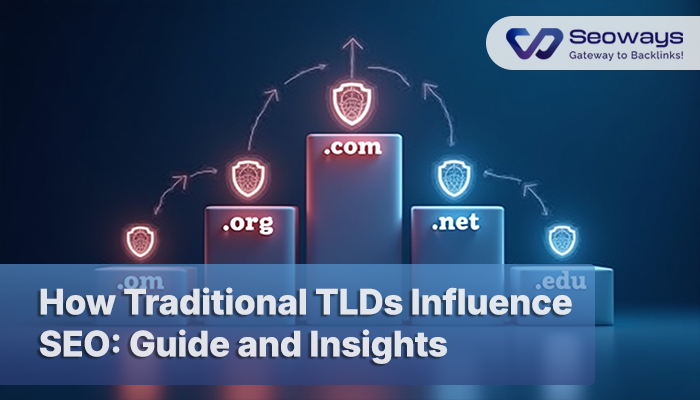
TLD stands for top level domain. It is the part of the web address that comes after the dot. The most common ones you know are dot com, dot org, dot net, and dot edu. These are called traditional TLDs because they have been around since the early days of the internet.
Over the years, hundreds of new fancy extensions appeared like dot xyz, dot tech, dot blog, dot shop. But still, whenever someone hears a domain name, their brain first imagines it ending with dot com. That is the power of tradition.
I had a client who wanted to launch a health and fitness blog. He initially bought a dot info because it was cheap. But when he started promoting the blog, many users thought it looked suspicious. He kept getting messages asking if the site was real or some scam. Eventually, he invested in the dot com version of the name. Within months, his traffic doubled. The content was the same but people trusted it more.
Google has always said TLDs are not a direct ranking factor. But trust influences clicks, and clicks influence SEO. If people hesitate to click your link because of the domain extension, your CTR drops and Google picks that signal.
Even in 2025, dot com is the gold standard. It is easy to remember, global, and has a reputation for being safe. Whenever I run client campaigns, if they have a dot com, it feels like we are building on a stronger foundation.
For example, one of my ecommerce clients in Chennai had a dot shop extension. We worked hard on SEO, but their competitors with dot com versions always had an edge in brand recall. Eventually, they rebranded under a dot com, and their brand search volume grew faster. Sometimes it is not about search engines but about human psychology.
Dot org has its own charm. It is usually associated with organizations, NGOs, and communities. I once helped a small charity in Coimbatore move from a dot net to a dot org. The difference in donations and volunteer sign ups was surprising. People simply believed in the mission more when they saw the dot org.
From an SEO angle, dot org domains often attract natural backlinks. Journalists and bloggers trust them and are more likely to reference them, which indirectly boosts rankings.
Dot net may not be as glamorous as dot com or as respected as dot org, but it still holds value. Many tech companies and startups that could not get their dot com settled with dot net. I remember using a dot net for one of my side projects in web development. It ranked decently well, but whenever I shared it with non tech folks, I had to explain dot net is legit and not some random extension.
In SEO terms, dot net still works fine, but branding wise it is weaker compared to dot com.
Now this is where things get interesting. Dot edu and dot gov domains are heavily restricted. Only accredited institutions and government bodies can own them. That exclusivity gives them a lot of authority.
I once landed a backlink from a US university’s resource page for one of my client sites. That single link boosted rankings more than 50 random guest posts combined. The reason is simple. Search engines treat dot edu and dot gov as highly trustworthy.
Owning such a domain may not be possible for most businesses, but getting a mention or a link from them is like striking gold in SEO.
People often ask me if newer TLDs like dot xyz or dot shop can rank. The answer is yes, they can. But the road is bumpier.
For example, a friend of mine launched a crypto blog on a dot xyz domain. It ranked for a few months, then suddenly tanked after the Google spam update. Whether it was the content or the extension, we will never know for sure, but I suspect the extension did not help. On the other hand, his competitor with a dot com kept steady rankings even after the same update.
Newer TLDs can work if you are in a niche where they make sense, like dot tech for a tech startup. But for mainstream SEO and long term branding, traditional TLDs are like a safe bet.
SEO is not just about algorithms. It is also about human perception. I once showed two business cards at a networking event. One had a dot com, the other had a dot info. Everyone automatically reached for the dot com card. Nobody asked about the content, they judged the domain first. That small bias plays out online too.
People trust what feels familiar. Traditional TLDs are familiar, so they get more clicks, more shares, and more mentions. Those signals compound into better SEO performance.
One myth is that dot com always ranks better by default. Not true. If you have weak content, a dot com will not save you.
Another myth is that new TLDs cannot rank at all. Also not true. With strong content, good backlinks, and brand building, even dot xyz can rank. But it will take more effort to build user trust.
If you can get a dot com, always go for it. It is safe, memorable, and powerful for branding.
If you are a non profit or community driven project, dot org is perfect.
If dot com is not available, dot net is still a good option, especially for tech businesses.
If you are in education or government, dot edu and dot gov are unmatched for authority.
But if you want to stand out with a new TLD, make sure your branding is strong enough to carry it. Otherwise, you may struggle with credibility.
I learned the hard way that domain extensions are not just a technical detail. They carry emotional weight. They influence how people perceive your brand. And in SEO, perception often becomes performance.
My personal sites with dot com always felt easier to grow. My experiments with unusual TLDs were fun but challenging. If you are serious about building something long term, my advice is simple. Stick to tradition when you can.
Traditional TLDs may not be an official ranking factor according to Google, but in real life they matter a lot. They influence trust, clicks, and backlinks. They shape how people see your site even before they land on it. And all of that indirectly influences SEO.
So while the web keeps changing, some things remain the same. Dot com is still king. Dot org still commands respect. Dot edu and dot gov still carry authority. And dot net still hangs around like a dependable old buddy.
If you want to build trust and grow faster, do not overlook the power of a simple dot at the end of your domain.
| Section | Key Points |
| Intro | Story of choosing the wrong TLD |
| What Are Traditional TLDs | Definition and examples |
| Trust Factor | Why people trust traditional TLDs |
| Dot Com | Still the strongest choice |
| Dot Org | Credibility and natural backlinks |
| Dot Net | Reliable but less powerful |
| Dot Edu and Dot Gov | High authority and rare |
| Comparison | Traditional vs newer TLDs |
| Psychological Edge | Human perception matters |
| Myths | Clearing common misconceptions |
| Choosing the Right TLD | Practical advice |
| Lessons | Personal journey and observations |
| Final Verdict | Traditional TLDs still influence SEO |


Request your best quote today!”

With the #1 Digital Marketing Agency!
We specialize in SEO, driving traffic, enhancing online visibility, and transforming markets with innovative strategies.
Seoways LLP,
1st Floor, SKK Complex,
Mohanur Road,
TN – 637001
Skype/Telegram: Seoways
Phone: +91 959 77 00 888