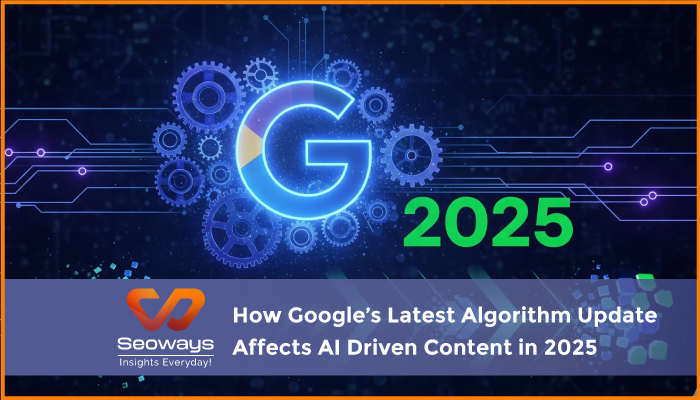
Artificial Intelligence has become the backbone of online content creation. Businesses, bloggers, and even agencies rely on AI tools to scale their publishing efforts. But when Google quietly rolled out its latest algorithm update in 2025, the ripple effect was immediate. Rankings shuffled, some sites saw traffic climb while others dropped sharply. The reason was clear. Google wanted to send a strong message about how AI driven content should be created, refined, and delivered.
This update is not just another technical tweak. It reshapes how search engines view AI content and forces marketers to rethink strategies.
Let us break it down.
For years, Google has repeated the same line. Focus on people first. Algorithms only exist to filter quality from noise. The 2025 update reinforced this principle by addressing the explosion of AI content that felt repetitive, shallow, or disconnected from real value.
The aim was not to punish AI usage itself. Instead, it was about identifying whether the content had clear intent, genuine usefulness, and contextual depth. Pages that relied on spinning tools or mass generated paragraphs lost visibility, while sites that blended AI with human editing and expertise gained ground.
Several shifts stood out in the new update.
The update changed the way businesses view AI tools. Instead of acting like shortcuts, AI systems are now seen as partners. The raw draft might still come from a machine, but the human touch is mandatory. Editors polish flow, insert perspective, and layer in authenticity.
Companies that leaned entirely on unedited machine text faced a decline. But those that invested in hybrid workflows where AI provided structure and humans refined substance saw better visibility.
Brands adapted quickly. Some started creating content labs, where AI generated first drafts and domain experts reviewed every section. Others invested in training staff to become AI editors instead of traditional writers.
An interesting shift is the rise of “voice personality.” Businesses realized that AI tools could sound generic. To stand out, they infused brand-specific vocabulary, subtle humor, and cultural context. This voice consistency became a competitive edge.
Another trend accelerated by this update is Google’s preference for multi format experiences. Pure text posts are no longer enough. The update rewarded pages that combined AI text with human produced videos, visuals, charts, and even podcasts.
This reflects how people consume knowledge today. Someone might skim a blog, another might prefer a 60 second video. AI alone cannot handle this diversity, but it can help draft transcripts, create summaries, and suggest content repurposing ideas. The combination is powerful.
Websites that had invested in high quality AI editing pipelines experienced steady growth. Their articles ranked well for competitive terms because they delivered clarity and freshness.
On the other hand, bulk content farms lost ground. They had flooded the web with thousands of generic AI posts, but the algorithm flagged them as low value. Even sites with strong backlink profiles could not escape penalties if content felt hollow.
If you create AI driven content in 2025, here are the takeaways from Google’s update:
This algorithm update marks a turning point. AI is not going away. In fact, it will keep getting smarter. But Google has drawn a clear line. Machines cannot replace human perspective. The winners will be those who know how to merge efficiency with authenticity.
By 2026, we may even see Google provide transparency tags like “AI assisted” versus “Human created.” But until then, the best strategy is balance. Use AI to scale, but never forget the importance of originality and human touch.
| Section | Key Focus | Why It Matters |
| Google’s Core Goal | People first content | Sets direction for ranking shifts |
| Ranking Signals | Context, engagement, authority | Defines what gets rewarded |
| AI as Partner | Human plus machine approach | Builds long term trust |
| Business Response | Hybrid workflows, brand voice | Shapes future strategies |
| Multi Format Content | Text plus visuals and audio | Matches user preferences |
| Practical Steps | Five actionable tips | Roadmap for success |


Request your best quote today!”

With the #1 Digital Marketing Agency!
We specialize in SEO, driving traffic, enhancing online visibility, and transforming markets with innovative strategies.
Seoways LLP,
1st Floor, SKK Complex,
Mohanur Road,
TN – 637001
Skype/Telegram: Seoways
Phone: +91 959 77 00 888