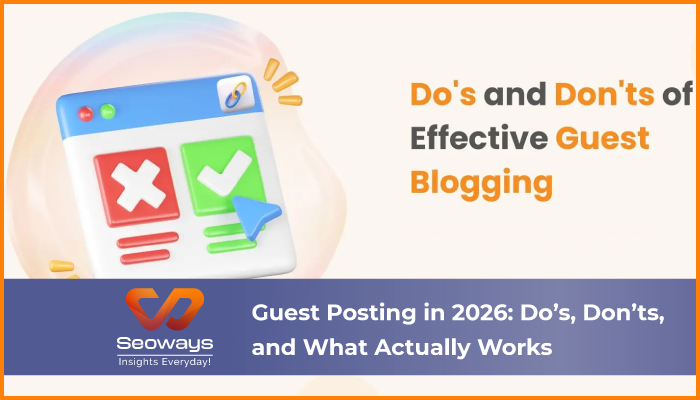
Guest posting is not dead in 2026.
But lazy guest posting absolutely is.
This confusion is why so many people think guest posting stopped working. What really stopped working is spammy outreach, recycled content, fake authority sites, and links built only to satisfy a checklist.
Search engines are smarter. AI systems are pickier. Users are impatient.
Guest posting still works when it feels natural, useful, and deserved. It fails when it feels forced.
If you are doing guest posting today, or planning to start, this is the reality you need to accept first.
Guest posting survives because the web still runs on recommendations.
A link is not just a ranking signal. It is a vote of confidence. When done correctly, guest posts serve three purposes at once.
They introduce you to a new audience.
They establish credibility through association.
They create a contextual signal that search engines trust.
None of these goals have changed. What changed is how they are evaluated.
Search engines now look at patterns instead of individual links. AI tools look at reputation instead of raw metrics. Users look at value instead of branding.
Guest posting works only when it aligns with all three.
The biggest shift in guest posting is not algorithmic. It is editorial.
In 2026, good guest posts read like original content written specifically for that site. Bad guest posts read like rented space.
Editors are more careful. Platforms are stricter. Even sites that accept guest contributions are filtering harder.
If your content feels generic, it will be ignored.
If your pitch feels transactional, it will be declined.
If your link placement feels forced, it will be removed later.
Guest posting is now closer to real publishing than link building.
Once you accept that, everything becomes clearer.
One of the most damaging habits is chasing numbers.
People still obsess over DA, DR, traffic estimates, and tool scores. These metrics are not useless, but they are secondary.
Relevance is primary.
A link from a smaller site that is tightly focused on your topic often performs better than a link from a massive general site that barely touches your niche.
Search engines understand topical relationships deeply now. They can tell when a mention makes sense.
If the audience overlaps, the link carries weight.
If the topic aligns, the content gets indexed faster.
If the context feels natural, the signal lasts longer.
Always ask one question first. Does this site genuinely make sense for my brand or page?
If the answer is no, move on.
The fastest way to fail guest posting in 2026 is submitting content that feels outsourced.
Editors can spot it instantly. So can users.
Every site has a tone, pacing, and expectation. Your guest post should feel like it belongs in their archive, not like a paid insert.
Study the site before pitching.
Match sentence length and structure.
Follow their content depth naturally.
Do not over explain. Do not over optimize. Do not write like you are trying to rank.
Write like you are contributing something worth publishing.
Link placement matters more than anchor text now.
A single contextual link inside a meaningful paragraph is far more valuable than multiple links stuffed into an author bio.
Search engines analyze surrounding content. AI systems look at sentence level meaning.
If your link adds clarity or reference, it works.
If it interrupts the flow, it weakens the page.
The best links feel invisible. They do not scream SEO. They quietly support the reader.
That is the standard.
Guest posting works best when it is consistent, not aggressive.
One burst of fifty posts followed by silence looks unnatural. A steady flow over months looks like reputation building.
Search engines track velocity. They track patterns. They track repetition.
Slow and steady always outperforms fast and loud.
Guest posting is not a launch tactic anymore. It is a brand tactic.
Scaling guest posting without strict quality control is the fastest way to burn a domain.
Most penalties and devaluations do not come from one bad link. They come from patterns of mediocre ones.
Thin content.
Duplicate ideas.
Repeated anchor styles.
Similar site templates.
All of these are red flags.
If you cannot maintain quality at scale, do not scale.
Ten strong guest posts outperform a hundred average ones every single time.
Outreach in 2026 is relationship based whether you like it or not.
Editors receive hundreds of pitches. Most are ignored within seconds.
Generic outreach fails because it signals zero effort.
If you want replies, show that you understand the site.
Reference a recent article genuinely.
Pitch a topic that fits their audience.
Keep it short and respectful.
You are not asking for a favor. You are offering content.
That mindset shift alone improves response rates dramatically.
Exact match anchors are not dead, but careless usage is dangerous.
Search engines expect variation. Real writers do not repeat the same phrases unnaturally.
Branded anchors.
Natural phrases.
Partial matches.
Contextual mentions.
A healthy profile looks messy, not perfect.
If your anchor text strategy looks engineered, it will eventually be discounted.
One of the worst habits is forgetting about guest posts after publication.
In 2026, link maintenance matters.
Sites update content. Pages get pruned. Links get removed quietly.
Monitor your placements.
Revisit published posts.
Update content when needed.
A guest post that stays relevant continues passing value. A forgotten one slowly fades.
Now let’s talk about what genuinely works right now.
Topical authority guest posting.
This means contributing multiple high quality posts within the same topic cluster across different but related sites.
Search engines recognize repeated expertise signals. AI systems notice consistent association.
You stop looking like someone buying links. You start looking like a known voice in the space.
That is the difference.
One powerful guest post helps.
Five aligned guest posts help more.
Twenty well placed posts over time establish authority.
Search engines evaluate the story your links tell.
Are you everywhere randomly, or are you consistently present in one ecosystem?
The second always wins.
Here is something most people ignore.
AI tools source answers from content that feels authoritative and well referenced.
Guest posts on reputable sites increase the chance that your brand or pages are picked up in AI generated answers.
This is not about rankings alone. It is about presence.
If your content is cited, referenced, or summarized by AI tools, guest posting indirectly supports that visibility.
Clean writing, strong context, and trusted platforms matter more than ever here.
Guest posting is moving closer to thought leadership.
It is less about links and more about reputation signals.
Those who adapt will benefit quietly. Those who chase old tactics will keep shouting that it no longer works.
Guest posting in 2026 rewards patience, clarity, and respect for the ecosystem.
If you do it right, it compounds.
If you do it wrong, it leaves footprints.
Guest posting is not a shortcut anymore.
It is a discipline.
When done with intent, it still drives rankings, traffic, and trust. When done carelessly, it does nothing or worse.
Focus on relevance.
Write like a contributor.
Build patterns, not spikes.
That is what actually works now.
| Section | Key Focus | Outcome |
| Guest Posting Basics | Why it still works | Clear understanding |
| Do’s and Don’ts | Best practices and mistakes | Risk reduction |
| What Actually Works | Proven modern strategies | Long term results |


Request your best quote today!”

With the #1 Digital Marketing Agency!
We specialize in SEO, driving traffic, enhancing online visibility, and transforming markets with innovative strategies.
Seoways LLP,
1st Floor, SKK Complex,
Mohanur Road,
TN – 637001
Skype/Telegram: Seoways
Phone: +91 959 77 00 888