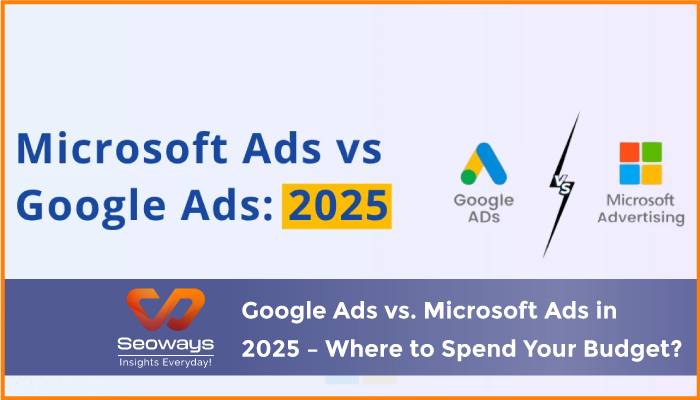
Every business owner, marketer, or agency eventually faces the same question: where should I spend my advertising money? In 2025, the debate between Google Ads and Microsoft Ads is more alive than ever. Both platforms offer unique advantages, different audiences, and tools that can deliver powerful results when used strategically. But the key lies in knowing which one makes sense for your goals.
Let’s unpack the differences, strengths, and challenges of both platforms and see where your budget should really go in 2025.
Paid advertising has changed a lot since the early days of sponsored text links. Google Ads, once called AdWords, started the revolution by offering keyword-based targeting. Microsoft Ads, previously Bing Ads, quietly built its own network and steadily gained ground.
In recent years, automation, AI-powered targeting, and audience-first strategies have transformed how campaigns work. The platforms are no longer just about showing up for a keyword. They are about reaching the right audience at the right time, often before they even realize they are searching.
Understanding this evolution is key because 2025 is not about choosing one platform blindly. It is about aligning platform strengths with your business objectives.
Google Ads reaches billions of people across Google Search, YouTube, Maps, and countless partner sites. The scale is unmatched. If you want maximum visibility, Google Ads delivers. But with reach comes competition and higher costs per click in many industries.
Microsoft Ads, though smaller, offers a different flavor. It powers Bing, Yahoo, AOL, and is deeply integrated with Windows devices and Microsoft’s ecosystem. That means users searching through Microsoft tend to be slightly older, more established, and often with higher disposable incomes. In industries like finance, travel, and B2B, Microsoft Ads can actually outperform Google in ROI because of its audience profile.
This difference is often overlooked, but it is one of the biggest factors in deciding where your ad dollars should go.
In 2025, Google Ads is still the pricier option. High demand industries like insurance, law, and healthcare see sky-high CPCs that make smaller businesses cautious. Microsoft Ads, meanwhile, usually comes with lower competition, meaning lower CPCs and sometimes better ad placement at a fraction of the cost.
But cheaper clicks do not always equal better performance. It depends on what you are after. For mass brand awareness, Google’s size justifies the cost. For efficient conversions in specific niches, Microsoft can be the smarter play.
Both platforms are constantly evolving. Google Ads leads in terms of AI automation, smart bidding strategies, and advanced audience insights. The integration with Google Analytics and YouTube ads gives it an unbeatable ecosystem.
Microsoft Ads has caught up impressively. In 2025, it integrates LinkedIn targeting data, giving advertisers the ability to run campaigns based on job titles, industries, and company size. This is a goldmine for B2B marketers. It also supports automation, audience targeting, and AI-powered recommendations similar to Google.
The difference is not in the existence of tools but in how they align with your goals. A fashion e-commerce brand may thrive on Google’s reach and Shopping campaigns. A B2B SaaS company may find Microsoft Ads a hidden gem because of LinkedIn integration.
User behavior matters. Google dominates mobile search. With billions of people using smartphones, Google captures most of those intent-driven searches. Microsoft Ads, however, has a stronger presence on desktops because of Windows default settings and corporate environments.
So if your target audience is professionals searching during office hours on desktops, Microsoft Ads could deliver stronger results. If you need to target people on the move, searching for restaurants, services, or shopping on their phones, Google Ads is non-negotiable.
Both Google and Microsoft are leaning heavily into AI. Campaigns are becoming less about manually adjusting bids and more about feeding the right data into the system. Google’s Performance Max campaigns, for example, let advertisers run across Search, Display, YouTube, and more in one go. Microsoft has launched similar AI-driven campaigns that optimize placements and bids.
The future is less about control and more about guidance. Advertisers now need to focus on creative assets, audience signals, and conversion tracking to get the most out of these AI-driven engines.
There is no universal answer, but here’s a framework:
The best strategy for many businesses in 2025 is not choosing one over the other but balancing both. Test campaigns, measure ROI, and let the data tell you where to scale.
The old debate of Google vs. Microsoft Ads is evolving into a smarter question: how can both platforms work together to maximize results? Marketers who split-test, diversify, and align ad spend with audience insights will be the ones who thrive in 2025.

| Section | Key Insight | Why It Matters |
| The Evolution of Paid Search | From keywords to AI-powered targeting | Shows how strategy must adapt |
| Audience Differences | Google has reach, Microsoft has quality | Helps choose platform based on audience |
| Cost and Competition | Google is pricier, Microsoft cost-efficient | Determines budget planning |
| Features and Tools | Google leads in automation, Microsoft in B2B | Match features with goals |
| Mobile vs. Desktop | Google owns mobile, Microsoft owns desktop | Align with user behavior |
| AI and Automation | Campaigns rely on data and creative assets | Future-proof strategy |
| Where to Spend in 2025 | Balance both based on ROI | Practical decision-making |