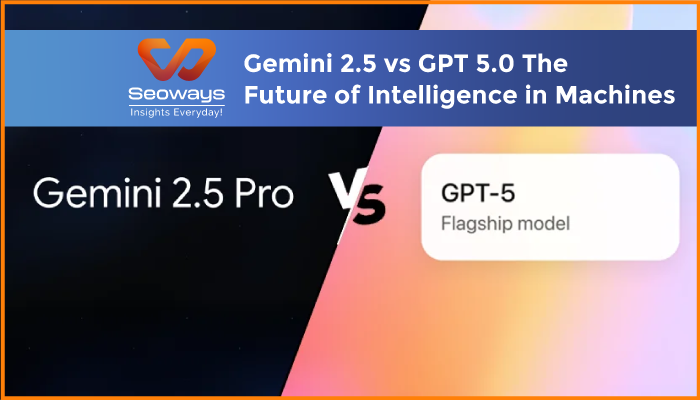
Artificial intelligence is no longer a silent background player. It has become the spotlight of innovation, disrupting industries, powering businesses, and influencing daily lives. In this evolving story of machines learning to think, two titans stand out. Gemini 2.5 from Google DeepMind and GPT 5.0 from OpenAI. Both represent the pinnacle of progress in natural language models, yet they are built on different philosophies. Comparing them is like comparing two great athletes with unique strengths. The question is not just which is stronger but which is shaping the future in a more meaningful way.
Language models have transformed from text prediction systems into engines of reasoning, creativity, and interaction. Early models were basic, limited to forming coherent sentences. Today’s models can generate research, create art, solve math problems, and even guide scientific discovery. Gemini 2.5 and GPT 5.0 stand as landmarks in this journey, representing both competition and collaboration in the quest for higher intelligence.
Gemini 2.5 is built on the idea of merging deep learning with reinforcement learning in ways that mimic human adaptability. It is not just trained to predict text but to refine reasoning through trial, error, and feedback. One of its most notable features is its multimodal nature. Gemini can understand not only text but also images, audio, and even video with striking accuracy. This makes it particularly powerful in tasks that require contextual blending across formats.
Another defining characteristic of Gemini 2.5 is efficiency. Designed to consume fewer resources while producing more reliable results, Gemini has set a new benchmark for sustainable AI. It also integrates more seamlessly with Google’s ecosystem, making it a natural choice for businesses already leveraging their cloud infrastructure.
If Gemini focuses on adaptability and multimodal intelligence, GPT 5.0 embodies the pursuit of general intelligence. OpenAI has pushed boundaries by creating a model that does not just understand queries but anticipates needs. GPT 5.0 is not only larger in scale but more refined in reasoning. It has been trained with broader datasets, including specialized materials, to provide context that feels almost human.
One of its standout features is alignment. OpenAI has invested heavily in ensuring GPT 5.0 can deliver safe, ethical, and aligned responses. This makes it an ideal tool for enterprises where trust and compliance are paramount. The model also excels in personalization. It remembers preferences, adapts its tone, and crafts content that resonates with the individual using it.
Gemini shines in areas that require versatility. Its multimodal capabilities make it the leader in vision based applications, such as medical imaging, design, and creative storytelling. Its efficiency allows it to scale across devices, from powerful servers to lightweight applications. For organizations focused on building cross platform solutions, Gemini provides a flexible backbone.
Another advantage lies in its integration with Google’s ecosystem. Gemini naturally aligns with tools like Google Cloud, Workspace, and Android devices, creating an end to end environment that feels intuitive for enterprises and consumers alike.
GPT 5.0 dominates in natural conversation and reasoning. It is more fluent, more contextual, and more human like in interaction. It excels at generating long form content, engaging in nuanced debates, and assisting in complex problem solving. Where Gemini feels like a system designed to understand, GPT 5.0 feels like a partner designed to think alongside you.
Another strength lies in creativity. GPT 5.0 can draft novels, compose poetry, write scripts, or generate marketing campaigns with remarkable originality. It is not only a productivity tool but also a creative collaborator.
For businesses, the choice between Gemini 2.5 and GPT 5.0 depends on priorities. If an enterprise requires deep integration with Google’s infrastructure and multimodal intelligence, Gemini stands out as the practical option. On the other hand, if personalization, creativity, and natural conversation are critical, GPT 5.0 provides unmatched capabilities.
Financially, Gemini may prove more cost effective due to its resource efficiency, while GPT 5.0 could justify its price through higher productivity and creative value. Both have ecosystems of tools, APIs, and plugins that make them adaptable for business workflows.
Both Gemini and GPT are built with ethical safeguards, but their approaches differ. Gemini emphasizes control and reliability, ensuring that responses remain consistent across contexts. GPT focuses on alignment, attempting to reflect human values in every output.
This difference has social implications. Gemini could be better suited for applications where consistency and compliance matter most, such as healthcare or finance. GPT could thrive in areas where human like empathy and adaptability are valued, such as education, entertainment, and customer experience.
The competition between Gemini and GPT is not just about market share but about shaping the direction of AI. Their rivalry fuels innovation, pushing each to evolve faster. In the long term, both may influence how society perceives and interacts with artificial intelligence. The real winners will not just be the companies that develop them but the people who use them to expand their potential.
Predicting a clear winner is impossible because Gemini and GPT excel in different dimensions. Gemini 2.5 is like a disciplined athlete focused on precision and efficiency, while GPT 5.0 is the visionary artist pushing the boundaries of creativity and intelligence. The choice depends less on superiority and more on context. What matters is not which one is better universally but which one is better for your unique needs.
Gemini 2.5 and GPT 5.0 symbolize two distinct approaches to machine intelligence. One is rooted in fusion and multimodal understanding, while the other is driven by alignment and human like reasoning. Both are extraordinary, and together they define the future of artificial intelligence. In a world where machines are becoming companions and collaborators, the debate between Gemini and GPT is less about rivalry and more about the evolution of human potential.
| Section | Key Points |
| Rise of Generative Models | Evolution of language models into reasoning and creative tools |
| Gemini 2.5 The Philosophy of Fusion | Multimodal, efficient, Google ecosystem integration |
| GPT 5.0 The Pursuit of General Intelligence | General reasoning, personalization, alignment focus |
| Strengths of Gemini 2.5 | Versatility, multimodal intelligence, efficiency, integration |
| Strengths of GPT 5.0 | Natural conversation, creativity, problem solving |
| Business Implications | Gemini is cost effective and integrated, GPT excels in personalization and creativity |
| Ethical and Social Dimensions | Gemini emphasizes control, GPT focuses on alignment |
| The Future of AI Rivalry | Competition drives innovation and societal impact |
| Which One Will Lead | Contextual choice, no clear winner |
| Final Thoughts | Both symbolize different approaches to AI progress |


Request your best quote today!”

With the #1 Digital Marketing Agency!
We specialize in SEO, driving traffic, enhancing online visibility, and transforming markets with innovative strategies.
Seoways LLP,
1st Floor, SKK Complex,
Mohanur Road,
TN – 637001
Skype/Telegram: Seoways
Phone: +91 959 77 00 888