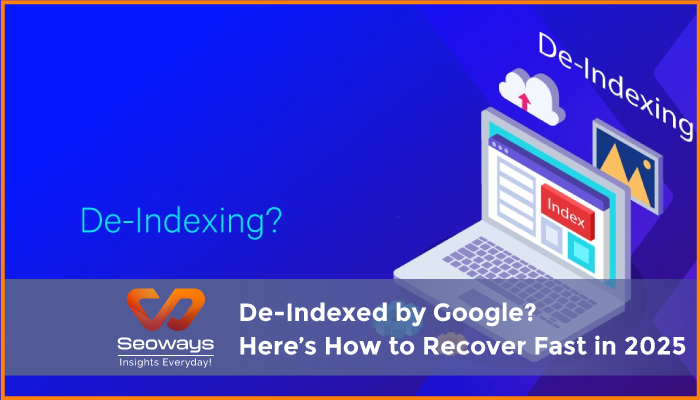
Waking up to find that your website has disappeared from Google is every business owner’s nightmare. Imagine investing months into content, design, and SEO only to see your hard work vanish overnight. This is what happens when a site is de indexed.
I still remember a client who called me in a panic one morning in 2022. His ecommerce site, which used to get thousands of visits daily, suddenly dropped to zero. He thought it was a technical glitch, but when I checked, the site was completely de indexed. Recovering it took weeks of work, but the lessons from that experience still guide how I help businesses today.
In 2025, the rules are tougher, the competition is sharper, and Google is more advanced than ever. But recovery is possible if you know what steps to take.
De indexed means that Google has removed your website or specific pages from its search results. This is not a ranking drop where you move from page one to page five. This is total invisibility. When your site is de indexed, people cannot find it even if they type your brand name.
Think of it like being removed from a public directory. You still exist, but no one can find you. For a business, this is like shutting the doors to your store without notice.
Google does not remove websites for no reason. There are usually clear signals that trigger this action.
Websites that engage in practices like cloaking, spammy backlinks, or hidden text often get flagged. Google’s priority is to protect users from low quality experiences.
If your site is filled with duplicate or machine generated content that adds no real value, Google sees it as untrustworthy.
Hacked websites that spread malware or phishing attacks are quickly removed to protect users.
Sometimes human reviewers at Google take manual action against sites that abuse the system.
A wrongly placed noindex tag, broken robots.txt file, or hosting issue can unintentionally block your site. I have seen businesses panic over de indexing only to discover it was caused by a misplaced line of code.
Before assuming the worst, check if your site is truly de indexed.
I once had a client who thought he was de indexed because he could not see his site. In reality, he had accidentally applied country filters in his search settings. Always double check before panicking.
Panicking will not solve the problem. Start by identifying the root cause. Is it technical, content related, or a penalty?
Search Console is your best friend here. It will tell you if there is a manual action or a crawling issue.
Look at your pages critically. Are they original? Do they provide real value? If not, start rewriting or removing low quality pages.
Run a malware scan. Many hosting providers offer built in security checks. Google also provides a Safe Browsing site status tool.
Ensure your robots.txt file is not blocking important pages. Check that your sitemap is clean. Remove accidental noindex tags.
If you receive a manual action, you will need to fix the issues and submit a reconsideration request. Be honest in your explanation. Google values transparency.
I helped a client in 2023 who was penalized for unnatural backlinks. We disavowed bad links, cleaned up the profile, and submitted a detailed reconsideration request. It took two months, but the site was re indexed and rankings gradually returned. The key was patience and honesty.
Content is often the biggest culprit in de indexing cases. Here is how to revamp it:
One of my own blog posts that was initially flagged for being “low value” was later revived by adding original research and personal case studies. That single update turned it into one of my best performing articles.
Prevention is easier than recovery. Here are the golden rules:
Every recovery story I have handled has taught me something new. The ecommerce client I mentioned earlier learned that fast content growth without quality checks can backfire. Another client discovered that cheap hosting with poor security was costing him credibility.
My own lesson came when I ignored a technical issue on my personal blog years ago. I had a broken sitemap and half my pages disappeared from Google. It took me weeks to figure it out. That experience made me obsessive about regular audits.
Business owners often underestimate the emotional toll of being de indexed. I have seen entrepreneurs lose sleep, stress about payroll, and even consider shutting down. But every single case that took corrective steps eventually recovered. De indexing is not the end. It is a wake up call to rebuild smarter.
With AI integrated deeply into Google’s systems, detection of poor practices is faster than ever. Recovery in 2025 requires more than fixing technical issues. It demands authenticity. Brands that focus on user value, transparency, and quality will not only recover but also build long term resilience.
| Sub Topic | Key Insight |
| What does de indexed mean | Complete removal from Google search visibility |
| Why sites get de indexed | Guidelines violation, poor content, malware, penalties, technical errors |
| How to confirm de indexing | Use site search, check Search Console, verify settings |
| Immediate recovery steps | Diagnose, audit content, scan security, fix technical errors |
| Manual penalty recovery | Fix issues and submit honest reconsideration request |
| Content revamp strategy | Remove duplicates, add depth, refresh old pages |
| Prevention tips | Guidelines, security, original content, avoid shady links |
| Real life lessons | Case studies from clients and personal experience |
| Emotional impact | Stress and panic are common but recovery is possible |
| Future outlook | AI demands authenticity and transparency |


Request your best quote today!”

With the #1 Digital Marketing Agency!
We specialize in SEO, driving traffic, enhancing online visibility, and transforming markets with innovative strategies.
Seoways LLP,
1st Floor, SKK Complex,
Mohanur Road,
TN – 637001
Skype/Telegram: Seoways
Phone: +91 959 77 00 888