
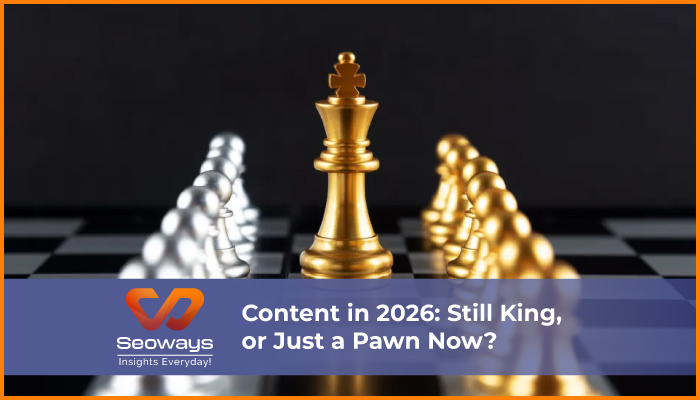
For years the phrase “content is king” has been thrown around like gospel. Every marketer, every SEO professional, every business owner heard it. But 2026 looks different. AI-driven search, personalized feeds, and evolving algorithms have changed the game. Content is still important, but is it the undisputed ruler, or has it quietly become a pawn in a much larger strategy?
The truth is nuanced. Content is no longer just about what you write. It is about how it interacts with AI, search engines, user behavior, and even other types of media. Understanding this distinction is crucial for anyone trying to thrive in SEO and digital marketing today.
The idea that content rules is not accidental. High-quality, relevant content attracts links, drives engagement, and builds trust. Historically, content served multiple functions simultaneously:
For instance, websites that consistently published guides and tutorials often saw growth in organic search, email subscribers, and social mentions. People read it, linked to it, shared it, and AI systems eventually recognized it as authoritative. Back then, a single well-written article could dominate a niche for months or even years.
Content was not just a piece of the puzzle. It was the puzzle.
Fast forward to 2026. AI is everywhere. ChatGPT, Bard, AI writing assistants, and AI-driven search engines have become the default first touchpoint for many users. People no longer just search with keywords; they ask questions, often expecting immediate, synthesized answers.
This changes the rules. A 2000-word blog post with perfect grammar is no longer enough. AI systems consider context, semantic relevance, engagement signals, and even past behavior. They might summarize your article without sending traffic to your site at all. Content itself is now part of a bigger ecosystem.
For example, a detailed guide on gardening might be read partially, quoted in AI generated answers, and have its traffic redirected to summary snippets. Your content is still valuable, but its role is shifting from being the sole driver of authority to one piece of a multi-layered puzzle.
In practice, simply producing content without supporting elements often falls short. Search engines and AI tools now favor a combination of:
A company producing high-quality articles but ignoring multimedia and structured data might struggle to rank compared to competitors who do all of the above. The AI does not just read words; it interprets signals around those words.
A small business publishing product guides without schema markup and proper internal linking may see half the organic traction compared to a competitor with fewer words but smarter technical SEO.
Even as AI changes the landscape, content has not lost all authority. It still forms the foundation for visibility. Without content, there is nothing for AI to summarize, nothing for search engines to index, and nothing for humans to engage with.
Content remains king in a few key ways:
A niche consulting firm producing deep industry reports may not get instant traffic from global search, but its content builds credibility that translates into high-value leads over time. That slow burn is critical in 2026, because authority is measured in multiple dimensions, not just clicks.
So when does content stop being king and start feeling like a pawn?
This happens when content exists in isolation. AI systems, search engines, and users now demand context. A well-written article without connections to authority signals, backlinks, internal links, structured data, or multimedia can get ignored.
Consider a blog post on personal finance. It may rank initially, but without mentions from reputable sites, engagement, or schema signals, AI assistants might not surface it in relevant queries. The content is still useful, but its power to influence results is limited. It becomes a pawn in a larger digital ecosystem that prioritizes trust and authority beyond just words.
Some small companies publish long how-to guides or in-depth comparisons and pair them with:
This combination often results in AI-driven search surfacing their content directly to users, leading to organic engagement, brand recognition, and conversions. The content is king, but it rules through a court of signals that elevate its authority.
2026 content strategy is no longer just articles. Videos, podcasts, images, infographics, and interactive tools amplify what text alone cannot. AI search systems prefer content that satisfies user queries in multiple formats.
A tech review site that combines concise written reviews with comparison charts, product images, and short explainer videos tends to rank higher than a site with longer text only. Content is still the king, but multimedia support is the royal guard that protects its territory.
Even perfect content cannot dominate if trust and authority signals are missing. Search engines evaluate historical behavior, backlinks from relevant sources, domain age, user engagement, and even AI model training data.
For instance, a health site producing accurate and well-researched content may still be outranked by a slightly older site with fewer words but more trusted backlinks. The content is a pawn here, helping reinforce authority rather than being the sole ruler.
Another layer in 2026 is optimizing content for AI-driven search. Structured headings, clear answers to questions, entity mentions, and conversational style improve AI understanding.
This approach allows content to play well with AI without losing human readability. It also ensures your content remains relevant even as search interfaces evolve.
The question is no longer just volume or quality. It is context, connections, and positioning. A strategy that works today combines:
A local consultancy focusing on small business SEO might write blogs answering common questions, integrate case studies, use videos to illustrate points, and gather reviews. Over time, content builds authority not in isolation, but in combination with multiple signals. This makes it both king and relevant in the modern context.
Even with AI and trust signals, content can reclaim the throne in certain scenarios:
In these situations, well-structured, original content can dominate visibility. It becomes a king supported by context rather than a pawn forgotten in the AI shuffle.
Content strategy in 2026 is about balance. Pure text alone cannot guarantee dominance. Multimedia, AI optimization, backlinks, trust signals, structured data, and engagement metrics all play a role.
Yet, at its core, content remains the anchor of your digital presence. Without it, AI systems, search engines, and users have nothing to interpret, summarize, or engage with. Content may share power now, but it still defines the court it sits in.
Content is no longer the uncontested king in 2026. It shares the throne with AI, trust signals, multimedia, and user engagement. At times it becomes a pawn if isolated, but when integrated with other factors, it still commands authority, visibility, and conversions.
For businesses and marketers, the lesson is simple: write with quality, optimize for AI, integrate signals, and build trust. That way, content rules wisely, not blindly.
| Section Topic | Focus Area | Key Takeaway |
| Why Content Was King | Historical perspective | Quality content drove authority, links, and engagement |
| AI and Content | 2026 search landscape | AI evaluates context, engagement, and signals beyond text |
| Content Alone vs Integrated | Strategy difference | Standalone content can be pawn, integration restores influence |
| Multimedia Role | Videos, charts, infographics | Amplifies content authority and visibility |
| Trust and Authority | Backlinks, engagement, schema | Signals determine ranking potential |
| Content Strategy Tips | Best practices | Combine quality, context, AI optimization, trust, and multimedia |


Request your best quote today!”

With the #1 Digital Marketing Agency!
We specialize in SEO, driving traffic, enhancing online visibility, and transforming markets with innovative strategies.
Seoways LLP,
1st Floor, SKK Complex,
Mohanur Road,
TN – 637001
Skype/Telegram: Seoways
Phone: +91 959 77 00 888