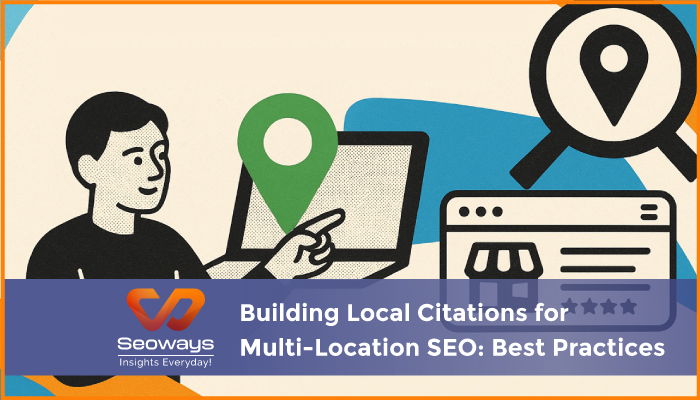
If your business has multiple locations, optimizing for local search can feel like juggling a dozen balls at once. I remember when I worked on a project for a regional restaurant chain with five outlets across the city. Each location had a different set of customers, slightly different services, and of course, different Google My Business listings. The challenge was clear: how do you make sure each location shows up in local search when people are looking for it?
The answer is building local citations. Local citations are mentions of your business’s name, address, and phone number across the web. For multi location businesses, citations are a critical part of SEO strategy. They help search engines verify your business information, boost local rankings, and drive more customers to each location.
In this guide, I will break down the best practices for building local citations for multi location SEO, share real life examples, and provide actionable tips that actually work.
Local citations are anywhere your business information appears online. This could be business directories, review sites, social media profiles, local blogs, or even maps. For example, your restaurant showing up on Yelp, TripAdvisor, or Yellow Pages counts as a citation.
Consistency is key. If your business name is spelled differently or your phone number changes across platforms, search engines get confused. That can hurt your rankings rather than help.
Local citations serve multiple purposes for multi location businesses:
In one of my projects, I noticed that a store location with incomplete citations received far fewer calls than the other locations, even though the website traffic was similar. Filling out accurate listings made a noticeable difference.
NAP stands for Name, Address, and Phone number. This is the foundation of local SEO.
For instance, if one location is listed as “Main Street” and another as “Main St.”, Google may see them as two different addresses. I once spent hours fixing inconsistencies for a client and saw rankings improve within weeks.
If your business has multiple locations, each should have its own page on your website. Include:
Linking these pages to local directories ensures the citations match the correct page, which improves SEO accuracy.
Not all citations are created equal. Focus on authoritative and relevant sources:
I once added citations to a few low quality directories for a client, and it had zero impact. Prioritize quality over quantity.
Multiple listings for the same location can confuse search engines and users. Audit directories regularly to merge or remove duplicates. Google My Business has a built in tool to report duplicates, which is incredibly useful.
Adding schema markup to each location page helps search engines understand your business information. Include NAP details, business type, opening hours, and geolocation data. This can improve your chances of appearing in rich results and local search features.
Citations and reviews work hand in hand. Encourage customers to leave reviews on each citation platform. Positive reviews improve rankings and influence potential customers. In my experience, a new location with only a few citations but strong reviews outperformed a fully listed location with no reviews.
Multi location SEO is an ongoing process. New directories appear, and information can become outdated. Set up a system to track all citations, check for consistency, and update them whenever business details change. I use a simple spreadsheet for smaller clients and tools like Moz Local or BrightLocal for larger networks.
Some directories allow you to add photos, videos, or virtual tours. Adding media not only enhances the listing but also increases user engagement. For example, a restaurant listing with photos of the interior and dishes gets far more clicks than a plain text listing.
Partner with local organizations, chambers of commerce, or event websites. Being mentioned on their websites acts as a local citation and can also drive traffic from a relevant audience.
For instance, one of my clients sponsored a local food festival. The event website listed all participating restaurants with addresses and links. That single citation boosted visibility and drove foot traffic.
| Tool | Key Feature | Benefit |
| Moz Local | Citation tracking and auditing | Identifies inconsistencies quickly |
| BrightLocal | Multi location citation management | Streamlines updates across directories |
| Whitespark | Citation building and monitoring | Helps find niche directories |
| Yext | Automated listing management | Keeps information consistent |
| Google My Business | Free listing management | Essential for local search presence |
Using these tools saves time, ensures accuracy, and reduces the risk of errors that could hurt rankings.
Building local citations for multi location SEO is not a one time task. It requires careful planning, consistency, and ongoing management. Each location should be treated individually, with accurate NAP, dedicated pages, authoritative directories, and regular updates.
From my experience, businesses that invest in well structured citation strategies see tangible improvements in local search visibility, website traffic, and even foot traffic to physical locations. Multi location SEO may seem complicated at first, but with systematic execution, it becomes a powerful tool for growth.
| Section | Key Points | Purpose |
| What Are Local Citations | Definition and examples | Introduces the concept |
| Why They Matter | Rankings, trust, traffic | Explains importance |
| Best Practices | NAP consistency, location pages, quality sources | Step-by-step actionable advice |
| Avoid Mistakes | Duplicates, low quality listings, neglect reviews | Warns beginners |
| Tools | Moz Local, BrightLocal, Whitespark | Provides practical solutions |
| Conclusion | Strategic and ongoing effort | Summarizes actionable advice |


Request your best quote today!”

With the #1 Digital Marketing Agency!
We specialize in SEO, driving traffic, enhancing online visibility, and transforming markets with innovative strategies.
Seoways LLP,
1st Floor, SKK Complex,
Mohanur Road,
TN – 637001
Skype/Telegram: Seoways
Phone: +91 959 77 00 888