
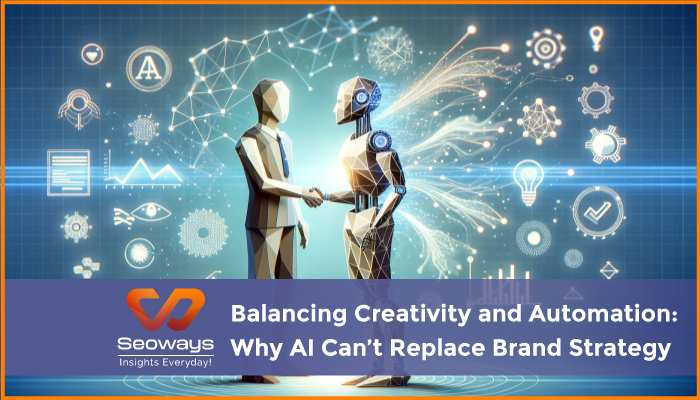
In the last few years, artificial intelligence has transformed the marketing landscape. AI can generate visuals, write copy, optimize ad delivery, and even predict trends with surprising accuracy. For many marketers, it feels like the future is here. But amid all the excitement, there is one crucial point that often gets overlooked. AI can automate tasks and streamline workflows, but it cannot replace the core of brand strategy.
Brand strategy is more than visuals or catchy copy. It is the story, personality, and values behind a business. It is the reason customers choose one brand over another. Without a clear strategy, even the most advanced AI tools will struggle to produce work that truly resonates.
This article explores why creativity and strategy remain irreplaceable, how AI can support them, and how marketers can strike the perfect balance.
At its core, brand strategy is the blueprint for how a brand communicates and connects with its audience. It encompasses:
These elements are deeply human. They involve intuition, empathy, cultural awareness, and emotional intelligence. AI can analyze patterns and suggest messaging, but it cannot fully grasp subtle human motivations or cultural context.
A strong brand strategy ensures that every marketing effort—whether automated or manual—aligns with the company’s core identity. Without it, campaigns risk looking polished but hollow.
AI has tremendous capabilities, but it also has limitations that every marketer should understand:
AI tools learn from data and patterns. They excel at predicting what has worked in the past. But brand strategy often requires looking forward and creating something entirely new. Anticipating market shifts, cultural movements, and customer desires requires vision that goes beyond historical data.
Human emotion drives connection. Customers respond to stories, humor, empathy, and even vulnerability. AI can mimic these elements, but it cannot genuinely feel or understand them. Marketing without authentic emotion risks feeling artificial, no matter how well it is optimized.
If a brand relies too heavily on AI-generated content, the voice and personality may shift unintentionally. Inconsistent messaging can confuse audiences and weaken brand loyalty. Maintaining a coherent identity requires human oversight.
While AI cannot replace brand strategy, it can enhance it. The most successful marketers treat AI as a tool that amplifies human creativity rather than a substitute.
AI can generate multiple variations of copy, visuals, or layouts in minutes. This allows creative teams to test ideas quickly and focus on refining the ones that truly align with the brand.
AI can analyze customer behavior, social trends, and engagement patterns to inform strategy. Marketers can identify what resonates and why, making strategic decisions faster and with more confidence.
AI excels at tailoring messages for different audience segments. By handling repetitive personalization tasks, it frees human teams to focus on high-level creative decisions that drive emotional impact.
Even with powerful AI, certain elements of marketing remain strictly human:
These elements are essential for long-term brand loyalty and cannot be automated. AI may assist in executing strategy, but humans must define it.
The most effective brands are those that integrate AI into their creative processes rather than relying on it exclusively. Here’s how a collaborative approach works:
| Step | Human Role | AI Role |
| Ideation | Define brand objectives and tone | Generate variations for testing |
| Content Creation | Refine voice and storytelling | Suggest headlines, images, and layouts |
| Audience Engagement | Interpret emotional responses | Analyze engagement patterns and recommend adjustments |
| Performance Monitoring | Decide strategic pivots | Optimize campaigns based on real-time data |
By combining human creativity with AI efficiency, brands can achieve faster, smarter, and more impactful marketing outcomes without losing authenticity.
Over-reliance on AI can lead to several risks:
The solution is simple. AI should handle repetitive, time-consuming tasks, leaving humans free to focus on strategy, storytelling, and the nuances that make a brand unforgettable.
The future of marketing is not AI versus humans. It is humans and AI working in harmony. Brands that succeed will be those that:
In this evolving landscape, marketers are becoming both strategists and orchestrators. AI will handle the operational side, but the vision, ethics, and soul of the brand will remain human.
AI is transforming marketing, but it is not a replacement for brand strategy. Creativity, storytelling, emotional intelligence, and long-term vision are irreplaceable human qualities. The most effective approach is to strike a balance: use AI to automate, accelerate, and analyze, while humans define, refine, and inspire.
Brands that master this balance will thrive in an AI-driven world, creating campaigns that are not only efficient but also memorable and deeply human.
| Section | Key Takeaways | Why It Matters |
| Introduction | AI is transforming marketing | Marketers must balance automation with strategy |
| What Brand Strategy Means | Mission, voice, positioning, values | Provides the foundation for all marketing efforts |
| Why AI Cannot Replace Strategy | AI is reactive and emotionless | Highlights the need for human insight |
| How AI Supports Creativity | Ideation, insights, personalization | Enhances human creativity without replacing it |
| Human Touch | Storytelling, culture, ethics | Maintains brand authenticity and loyalty |
| Collaboration | Human-AI workflows | Ensures efficiency and creative quality |
| Pitfalls of Over-Automation | Generic content, brand dilution | Warns against over-reliance on AI |
| Future Outlook | Harmonizing AI and humans | Guides long-term marketing success |
| Final Thoughts | Balance is key | Emphasizes human creativity and AI efficiency |


Request your best quote today!”

With the #1 Digital Marketing Agency!
We specialize in SEO, driving traffic, enhancing online visibility, and transforming markets with innovative strategies.
Seoways LLP,
1st Floor, SKK Complex,
Mohanur Road,
TN – 637001
Skype/Telegram: Seoways
Phone: +91 959 77 00 888