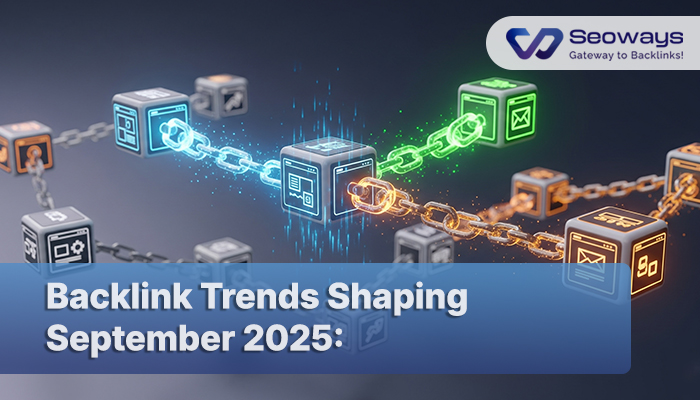
Backlinks have always been the oxygen of SEO, but what’s striking is how their role keeps evolving. The game in September 2025 looks nothing like it did in 2022—or even last year. Search engines are sharper, competitors more aggressive, and outdated link tactics can burn both your time and money.
This guide cuts through the noise. Instead of drowning you in theory, I’ll walk you through the backlink trends that are working right now—based on live campaigns I’ve run at SEOWays. These are real examples, real shifts, and strategies you can test today.
Google’s focus has shifted from domain authority to page-level topical authority. In plain English: one link from a niche expert site can outperform twenty links from big but irrelevant sites.
For example, I worked with a SaaS client where a single backlink from a specialized industry blog beat a pile of generic DR 80 guest posts. The message is clear—don’t chase metrics blindly. Go after sites that actually influence your niche.
Buying guest posts isn’t dead, but it’s losing edge. What’s gaining momentum are organic editorial mentions—links that appear naturally within real stories.
I tested this when a journalist covered one of my clients in a tech roundup. That single mention pushed their homepage up three positions in just two weeks. Meanwhile, ten paid posts barely budged rankings. Why? Because trust is baked into editorial coverage, and Google knows it.
Thin, 400-word articles don’t cut it anymore. Google values contextual depth—think 1,200+ words, detailed explanations, visuals, data, and expert insights.
In one campaign, I placed backlinks for a client on two sites with similar authority. One was inside a short news update, the other in a deep guide packed with stats and graphics. The second outperformed the first by a factor of three. Depth multiplies link equity.
Many marketers ditched tier two link building years ago. But in 2025, it’s back in play. Supporting your tier one placements with Web 2.0s, PDFs, or niche edits increases both crawl speed and authority flow.
I boosted a client’s top-tier placements with a layer of tier two links and saw noticeable ranking jumps within a month. This layered approach is quickly becoming a power move again.
If you’re running international campaigns, regional backlinks are a must. Even global brands perform better when supported by country-specific mentions.
For a U.S. SaaS client expanding into India, we built links from Indian startup forums and tech blogs. Their India-focused landing page climbed rapidly—proof that local context drives relevance.
Social shares used to be seen as “nice but irrelevant.” Now, they appear to amplify backlinks. When a post gets traction on LinkedIn or X, the associated links deliver faster results.
One crypto client saw this firsthand. A guest article gained attention on X thanks to a few influencers. That backlink indexed faster than usual and pushed rankings within days. Search engines are listening to social signals more closely than ever.
Even unlinked brand mentions are influencing rankings. When your brand gets cited alongside industry leaders, Google builds an association of trust. Add backlinks on top of that, and the effect compounds.
In campaigns where clients had strong PR presence, their backlink results accelerated. Brand authority amplifies link equity—so PR and link building should go hand in hand.
Mass-blasting hundreds of backlinks might create temporary spikes, but it’s also a red flag. Google favors a natural growth pattern over aggressive link velocity.
One ecommerce client penalized in 2023 saw recovery after pruning bad links and rebuilding slowly with clean, consistent placements. A steady profile beats a noisy one—always.
Closed communities, member-only blogs, and invite-only publications are becoming valuable backlink sources. Scarcity creates trust, and Google values exclusivity.
For a healthcare client, I secured a backlink from a private association site. Despite a modest DR, that single link moved competitive keywords faster than public blogs with bigger numbers. Hard-to-get links now carry serious weight.
The safest strategy for 2025 is diversification. The strongest link profiles don’t rely on just one tactic. Instead, they weave together editorial mentions, niche guest posts, local coverage, tier two support, and private community links.
At SEOWays, we treat backlinks as an ecosystem. Every link supports the next, forming a natural story that’s resilient against algorithm shifts. If one piece weakens, the system still holds.
| Sub Topic | Key Insight | Personal Note |
| Authority first linking | Topical authority > domain DR | SaaS case study: one niche blog beat twenty generic sites |
| Editorial mentions | Natural links > paid posts | Journalist link outperformed 10 paid placements |
| Contextual depth | Long guides deliver stronger value | Deep content boosted rankings 3x |
| Tier two revival | Supporting links amplify tier one | Web 2.0 + docs revived guest posts |
| Local relevance | Regional links matter globally | Indian blogs powered U.S. SaaS growth |
| Social signals | Shares amplify backlink effect | Crypto post shared on X indexed fast |
| Brand mentions | Even unlinked mentions help | PR + backlinks accelerated results |
| Clean profile | Consistency > speed | Ecommerce site rebounded after penalty |
| Private communities | Exclusive sites carry weight | Healthcare client link moved fast |
| Diversified strategy | Mix of link types future-proofs SEO | Ecosystem approach is safest |


Request your best quote today!”

With the #1 Digital Marketing Agency!
We specialize in SEO, driving traffic, enhancing online visibility, and transforming markets with innovative strategies.
Seoways LLP,
1st Floor, SKK Complex,
Mohanur Road,
TN – 637001
Skype/Telegram: Seoways
Phone: +91 959 77 00 888